
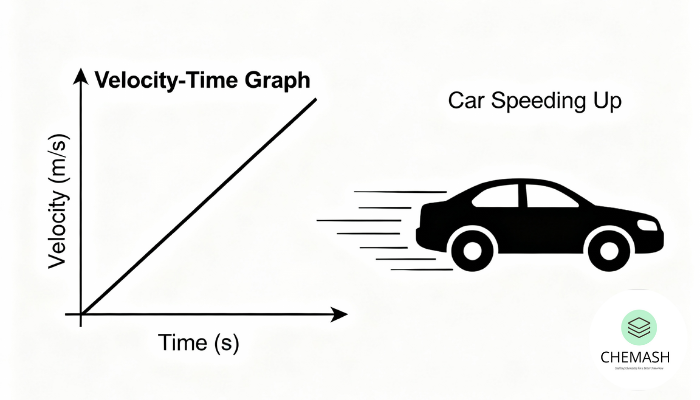
Acceleration is an important physical quantity that explains how fast the velocity of an object changes with time. It helps us understand whether an object is speeding up, slowing down, or changing direction.
What is Acceleration?
Accelerations (a) is defined as the rate of change of velocity with respect to time.
Formula:
a = (v − u) / t
- a = Acceleration
- v = Final velocity
- u = Initial velocity
- t = Time taken
Units of Acceleration:
- SI Unit: m/s²
- C.G.S Unit: cm/s²
Important Points:
- If velocity increases → acceleration is positive
- If velocity decreases → acceleration is negative (also called retardation / deceleration)
- If velocity does not change → accelerations is zero
Types of Acceleration
1)Uniform Acceleration
When the acceleration remains constant throughout the motion.
Example: A car moving in a straight line while increasing its velocity at a steady rate of 2 m/s every second.
2)Non-Uniform Acceleration
When the acceleration changes with time.
Example: A car moving in heavy traffic where velocity continuously increases and decreases.
3)Centripetal Acceleration
A type of acceleration that acts towards the center of a circular path, responsible for changing the direction of velocity during circular motion.
Example: Motion of a bike on a circular track.
Example Numerical
A bus increases its velocity from 10 m/s to 25 m/s in 5 seconds. Find its accelerations.
Given:
- u = 10 m/s
- v = 25 m/s
- t = 5 s
Using formula: a = (v − u) / t
a = (25 − 10) / 5 = 15 / 5 = 3 m/s²
Answer: The accelerations of the bus is 3 m/s²
Accelerations vs Velocity — Quick Comparison
| Feature | Velocity | Acceleration |
|---|---|---|
| Meaning | Rate of change of displacement | Rate of change of velocity |
| Formula | v = s / t | a = (v − u) / t |
| Quantity Type | Vector | Vector |
| Zero Value | Velocity can be zero while object is stationary | Accelerations can be zero even if object is moving at constant velocity |
MCQs — Practice Questions
- If velocity of an object increases, its accelerations is:
(a) Zero (b) Negative (c) Positive (d) Infinite
Answer: (c) - The SI unit of accelerations is:
(a) m/s (b) m/s² (c) km/h (d) N
Answer: (b) - Accelerations is zero when:
(a) Velocity is constant (b) Velocity is increasing (c) Time is zero (d) Displacement is zero
Answer: (a)
Quick Quiz (Self-Check)
- A car goes from 20 m/s to 50 m/s in 6 seconds. What is its accelerations?
- Can accelerations be negative? Explain with an example.
- Which type of accelerations occurs in circular motion?
Conclusion
Accelerations measures how quickly the velocity of an object changes with time. It can be positive, negative, or zero depending on the nature of motion. There are three types of accelerations — uniform, non-uniform, and centripetal — each playing a major role in understanding motion in Physics.
