
Identification, characterization and quantification of organic compounds — qualitative & quantitative methods, modern instrumental techniques, worked example, MCQs and FAQs for study .
Table of Contents
- 1. Qualitative Analysis
- 1.1 Detection of Elements & Functional Groups
- 2. Quantitative Analysis
- 2.1 Empirical & Molecular Formula (example)
- 3. Modern Techniques
- 4. MCQs, True/False & Fill-in
- 5. FAQs
- 6. Summary
1. Qualitative Analysis
Qualitative analysis determines which elements and functional groups are present in an organic compound.
Detection of Elements
- Carbon & Hydrogen: Heat with CuO → CO₂ & H₂O. CO₂ turns lime water milky (Ca(OH)₂), H₂O detected by anhydrous CuSO₄ turning blue.
- Nitrogen: Lassaigne’s test — fusion with sodium produces extract that gives Prussian blue with FeSO₄ (shows presence of N in many organic molecules).
- Halogens: Lassaigne’s extract + AgNO₃ gives precipitates (AgCl white, AgBr pale yellow, AgI yellow).
- Sulfur: Lassaigne’s extract can give lead sulfide (PbS) black precipitate with lead acetate, or test via sodium nitroprusside methods.
- Phosphorus: Fusion with Na₂O₂ or Na metal and testing with ammonium molybdate gives yellow/blue phosphomolybdate complexes.
Detection of Functional Groups
- Alcohols: Lucas test (tertiary reacts fastest), ceric ammonium nitrate gives color for some alcohols.
- Aldehydes / Ketones: 2,4-DNP (carbonyl detection); Tollens’ reagent gives silver mirror for aldehydes (not ketones).
- Carboxylic acids: Effervescence with NaHCO₃ (CO₂ evolution).
- Amines: Hinsberg’s test (solubility behavior), diazotization for primary aromatic amines.
2. Quantitative Analysis
Quantitative analysis determines percentage composition and allows calculation of empirical and molecular formulas.
Key Techniques
- Combustion analysis (C & H): Burning the compound and collecting CO₂ and H₂O to determine %C and %H.
- Nitrogen: Kjeldahl’s method (commonly used) or Dumas method (combustion & gas analysis).
- Halogens, S, P: Carius method (oxidative digestion followed by gravimetric analysis) and other halogen-specific titrations.
Empirical & Molecular Formula (Worked Example)
Example: Compound composition: 40.00% C, 6.67% H, 53.33% O. Convert to moles (assume 100 g sample): C: 40 g /12.01 = 3.33 mol; H: 6.67/1.008 = 6.62 mol; O: 53.33/16.00 = 3.33 mol → ratio C:H:O ≈ 1:2:1 → Empirical formula CH2O. If molar mass ≈ 180 g·mol⁻¹, molecular formula = C6H12O6.
3. Modern Techniques of Organic Analysis
- Chromatography: TLC (quick qualitative), GC (volatile compounds), HPLC (non-volatile/polar analytes). Used for separation, purity check, quantification.
- Spectroscopy:
- UV–Vis: Conjugation and π→π* transitions; useful for concentration via Beer–Lambert law.
- IR: Functional-group fingerprinting (C=O ~1700 cm⁻¹, O–H broad ~3200–3600 cm⁻¹).
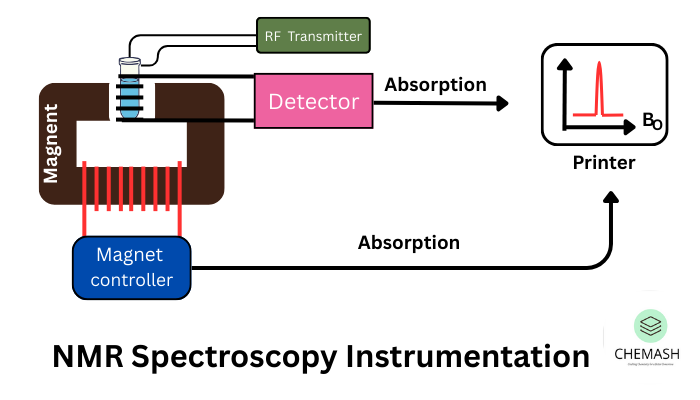
- NMR (¹H, ¹³C): Local chemical environment, coupling patterns, integration → structure elucidation.
- Mass Spectrometry: Molecular ion peak gives M⁺·; fragmentation pattern helps deduce structure.
Combining chromatographic separation with MS (GC–MS or LC–MS) gives powerful qualitative & quantitative identification in complex mixtures.
4. MCQs
MCQ 1: Which element is detected by the formation of a black precipitate with lead acetate?
A) Nitrogen B) Sulfur ✅ C) Phosphorus D) Halogen
Explanation: Sulfur forms PbS (black).
MCQ 2: Which test gives a silver mirror for aldehydes?
A) 2,4-DNP B) Tollen’s Test ✅ C) Lucas Test D) Fehling’s Test
Explanation: Tollens’ reagent reduces to metallic Ag with aldehydes.
MCQ 3: Which method is commonly used for nitrogen estimation?
A) Dumas B) Kjeldahl’s Method ✅ C) Lassaigne’s Test D) Victor Meyer
Explanation: Kjeldahl’s is standard for %N (biological & organic samples).
MCQ 4: IR spectroscopy is primarily used to identify:
A) Molecular weight B) Functional groups ✅ C) Hydrogen environment D) Chromatographic retention
Explanation: IR measures vibrational modes characteristic of functional groups.
True / False
- Effervescence with NaHCO3 indicates a carboxylic acid. — True
- Lassaigne’s test is quantitative for nitrogen. — False (it’s qualitative).
Fill in the blanks
- Combustion analysis measures CO₂ and H₂O to find %C and %H.
- NMR spectroscopy gives information about the hydrogen (¹H) environment of a molecule.
Extended MCQ Set (10 practice Qs with answers)
- Which reagent is used to detect halogens in Lassaigne’s extract? — AgNO3 (precipitates AgX)
- Which technique separates volatile organics? — GC
- Which MS peak indicates the molecular weight? — Molecular ion (M⁺·)
- Which NMR parameter shows number of protons? — Integration
- Which test detects primary/secondary/tertiary alcohols differences quickly? — Lucas test
- Which method uses fuming HNO3 & AgNO3 for halogens? — Carius method
- Which spectroscopy uses ppm chemical shift? — NMR
- Which technique is best for initial quick polarity check in organic labs? — TLC
- Which method uses ammonium molybdate reagent? — Phosphorus detection
- Which reagent forms 2,4-DNP orange/yellow precipitate? — 2,4-Dinitrophenylhydrazine
5. Frequently Asked Questions
Which test detects nitrogen in organic compounds?
Lassaigne’s test (fusion with sodium, extraction and reagents) is commonly used to detect the presence of nitrogen qualitatively.How are carbon and hydrogen detected in qualitative analysis?
Combustion with CuO produces CO₂ (lime water test) and H₂O (anhydrous CuSO₄ indicator).What is Kjeldahl’s method used for?
Kjeldahl’s method estimates nitrogen content quantitatively in organic and biological samples.What does IR spectroscopy tell you?
IR identifies functional groups by their characteristic absorption bands (e.g., C=O, O–H, N–H).Why combine chromatography and mass spectrometry?
Chromatography separates components; coupling to MS gives exact mass and fragmentation for definitive identification.
Summary
Analysis in organic chemistry blends classical wet-chemistry tests (Lassaigne, Kjeldahl, Carius, combustion) with modern instrumental tools (TLC/GC/HPLC, IR, NMR, MS). Use a stepwise approach: separate → detect → confirm → quantify. Practice with MCQs and include clear examples in your notes for exam-ready recall.
Related: Types of Polymers • Polymerization Reactions •
External ref: RSC
© 2025 CHEMASH
