
Breathing & Respiration – CHEMASH Biology
Breathing and respiration are often confused but they are different processes. This chapter is highly important for Class 10, 11, 12 Boards & NEET 2026.
Related Topics: Human Digestive System | Respiration in Plants | Enzymes & Metabolism
Table of Contents
- Breathing vs Respiration
- Mechanism of Breathing
- Types of Respiration
- Respiration Equation
- Aerobic vs Anaerobic
- MCQs
- FAQs
Breathing vs Respiration
| Feature | Breathing | Respiration |
|---|---|---|
| Definition | Physical process of inhaling & exhaling air | Chemical breakdown of food to release energy |
| Type | Mechanical | Biochemical |
| Energy Release | No energy produced | ATP produced |
Mechanism of Breathing
Inhalation (Inspiration)
- Diaphragm contracts
- Chest cavity expands
- Air enters lungs
Exhalation (Expiration)
- Diaphragm relaxes
- Chest cavity decreases
- Air leaves lungs
Important: Gas exchange occurs in alveoli of lungs.
Types of Respiration – Detailed Explanation
Respiration is the process by which cells break down glucose to release energy in the form of ATP. There are two main types of respiration:
1️⃣ Aerobic Respiration
Aerobic respiration is the process of breaking down glucose in the presence of oxygen to produce a large amount of energy.
Overall Equation:
C₆H₁₂O₆ + 6O₂ → 6CO₂ + 6H₂O + 36-38 ATP
Where It Occurs:
- Glycolysis – Cytoplasm
- Krebs Cycle – Mitochondrial matrix
- Electron Transport Chain – Inner mitochondrial membrane
Energy Yield:
- Produces 36–38 ATP molecules
- Highly efficient process
End Products:
- Carbon dioxide (CO₂)
- Water (H₂O)
Important for NEET:
Maximum ATP is produced during the Electron Transport Chain through oxidative phosphorylation.
2️⃣ Anaerobic Respiration
Anaerobic respiration is the breakdown of glucose in the absence of oxygen. It produces less energy compared to aerobic respiration.
Occurs In:
- Yeast
- Some bacteria
- Human muscle cells (during vigorous exercise)
Energy Yield:
- Only 2 ATP molecules produced
- Less efficient
End Products:
In Yeast:
Glucose → Ethanol + CO₂ + 2 ATP
In Human Muscles:
Glucose → Lactic Acid + 2 ATP
Important Concept:
During intense exercise, oxygen supply becomes insufficient. Muscle cells switch to anaerobic respiration causing lactic acid accumulation, which leads to muscle cramps.
Respiration Equation
C₆H₁₂O₆ + 6O₂ → 6CO₂ + 6H₂O + Energy (ATP)
Aerobic vs Anaerobic Respiration
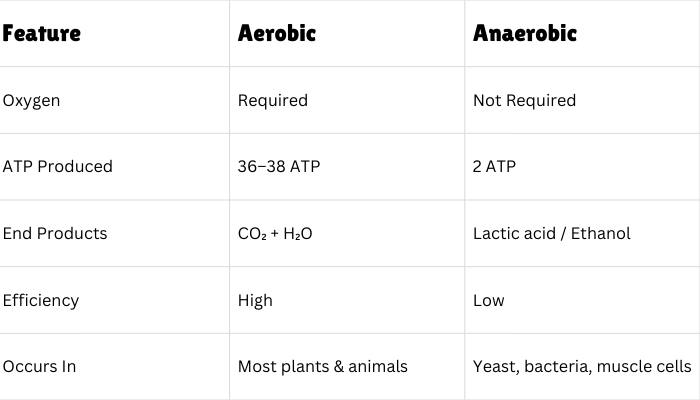
| Feature | Aerobic | Anaerobic |
|---|---|---|
| Oxygen | Required | Not Required |
| ATP Produced | 36-38 ATP | 2 ATP |
| End Products | CO₂ + H₂O | Lactic Acid / Ethanol |
MCQs (NEET 2026 Oriented)
1. Gas exchange occurs in:
Answer: Alveoli
2. Energy currency of cell is:
Answer: ATP
3. Anaerobic respiration produces:
Answer: Lactic acid (in muscles)
4. Breathing is a:
Answer: Mechanical process
FAQs
Q1. Is breathing same as respiration?
A: No. Breathing is physical process, respiration is chemical process.
Q2. Where does respiration occur?
A: Inside cells, mainly in mitochondria.
Official syllabus reference: NCERT Biology Textbook
Study with CHEMASH
CHEMASH provides affordable tuition for all classes (Biology, Chemistry & Physics). Experienced teachers, concept clarity, problem-solving sessions and weekly tests for Boards & NEET 2026. Trusted and helpful learning platform. Join CHEMASH Classes

Pingback: Human Circulatory System | Class 10, 11, 12 & NEET 2026 .