
Common Ion Effect | Definition, Examples, Applications & Quiz
Table of Contents
Definition
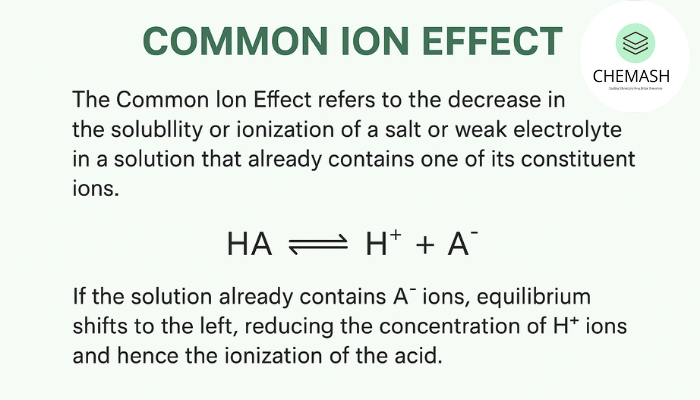
The Common Ion Effect refers to the decrease in solubility or ionization of a salt or weak electrolyte in a solution that already contains one of its constituent ions. This occurs due to Le Chatelier’s Principle, where adding more of a common ion shifts equilibrium to reduce ionization.
Explanation of the Effect
Consider the ionization of a weak acid HA:
HA ⇌ H+ + A-
If the solution already contains A- ions from another source, equilibrium shifts to the left, reducing H+ concentration and acid ionization.
Effects & Applications
- Reduced Ionization: Weak acids/bases ionize less in presence of common ion.
- Decreased Solubility: Solubility of salts decreases.
- pH Control: Basis for buffer solutions.
- Analytical Chemistry: Used in selective precipitation & ion separation.
Example
Solubility of AgCl in pure water is higher than in a solution containing NaCl. The equilibrium:
AgCl (s) ⇌ Ag+ + Cl-
shifts left when Cl- ions are added, reducing solubility.
MCQs Test Your Knowledge
- Common ion effects is explained using:
- a) Raoult’s Law
- b) Le Chatelier’s Principle ✅
- c) Dalton’s Law
- The solubility of AgCl decreases in presence of:
- a) HCl ✅
- b) NaOH
- c) H₂SO₄
- Which is an application of common ion effects?
- a) Buffer solution ✅
- b) Electrolysis
- c) Distillation
Quiz: Test Your Knowledge
- What is the common ion effect?
- How does the presence of a common ion affect a weak acid?
- Give an example involving AgCl.
- How is it useful in buffer solutions?
Frequently Asked Questions Test Your Knowledge
Q1. What is the common ion effects?
It is the reduction in solubility or ionization due to the presence of a shared ion.
Q2. Which principle explains it?
Le Chatelier’s Principle.
Q3. Where is it applied?
In buffer solutions, solubility control, and analytical chemistry.
Summary
