
Definition of Electric Charge
Electric charge is a fundamental property of matter that causes particles to experience electrical and magnetic forces. It is responsible for all electrical phenomena and is the basis of electronics and electrical systems.
What is Electric Charge?
Electric charges is the physical property of particles that allows them to interact through electromagnetic force. It is carried by subatomic particles such as electrons and protons. When electric charges move, they produce electric current.
Charge cannot be created or destroyed; it can only be transferred from one body to another. This principle is known as the conservation of electric charges.
Positive and Negative Charge
There are two types of electric charges: positive charge and negative charge.
Positive Charge
- Carried by protons
- Found in the nucleus of an atom
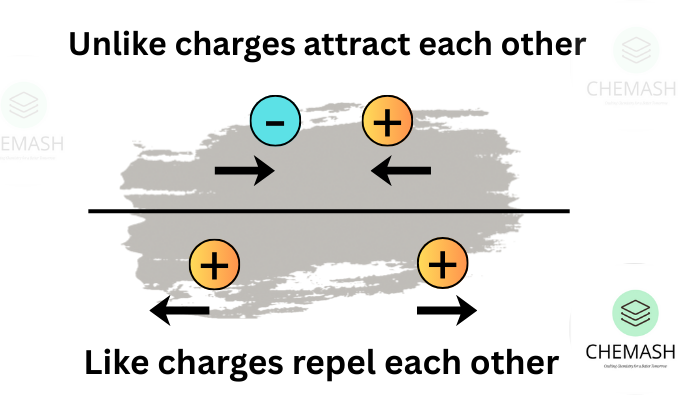
- Like charges repel, unlike charges attract
Negative Charge
- Carried by electrons
- Electrons move around the nucleus
- Responsible for electric current
Rule: Like charges repel each other, while opposite charges attract each other.
Charge of Electron and Proton
Electron
- Charge = -1.602 × 10⁻¹⁹ C
- Very small mass
- Negative charge
Proton
- Charge = +1.602 × 10⁻¹⁹ C
- Much heavier than electron
- Positive charge
Electrons and protons have equal magnitude of charge but opposite signs. An atom remains electrically neutral when it contains equal numbers of electrons and protons.
Elementary Charge
Elementary charge is the smallest unit of electric charge that exists independently in nature. It is denoted by the symbol e.
Value of elementary charge:
e = 1.602 × 10⁻¹⁹ coulomb
- Charge of one electron = -e
- Charge of one proton = +e
- All observable charges are multiples of e
Quantization of Charge
Quantization of charge means that electric charge exists in discrete packets and not in continuous values. Any charge present on a body is an integral multiple of the elementary charge.
Mathematical expression:
Q = n × e
- Q = total charge
- n = integer (0, ±1, ±2, ±3, …)
- e = elementary charge
This shows that fractional charges like 0.5e or 1.3e are not possible under normal conditions.
Conclusion
Electric charges is the foundation of electronics and electrical engineering. Understanding its definition, types, elementary charge, and quantization helps in studying electric circuits, electronic devices, and modern technology.
