
Faraday’s Laws of Electrolysis — Equations, Derivation, Examples & Applications
Faraday’s Laws of Electrolysis explain how the amount of electricity passed through an electrolyte is directly related to the mass of substance deposited or liberated at the electrodes. These laws form the foundation of electrochemistry. The key formula is:
m = (Q × M) / (n × F)
Where Q = It, M = molar mass, n = electrons per ion, and F = Faraday constant (96485 C·mol⁻¹).
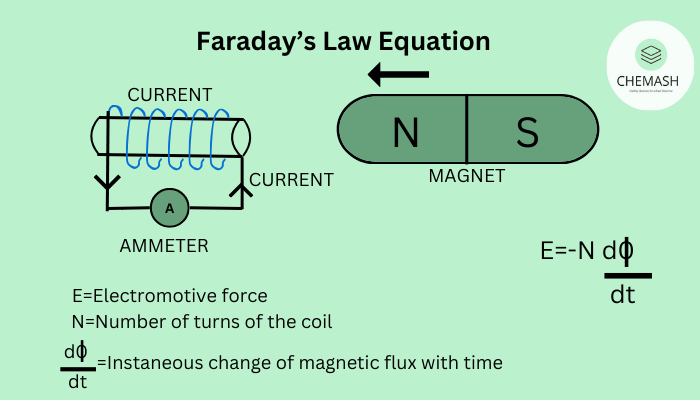
What Are Faraday’s Laws of Electrolysis?
Faraday’s laws describe how the mass produced at an electrode depends directly on the electric charge passed. These laws are essential for understanding electroplating, refining, metal extraction, and chemical analysis.
Faraday’s First Law (Quantitative Law)
The mass of a substance deposited or liberated is directly proportional to the total electric charge passed.
In simple terms: m ∝ Q
Faraday’s Second Law
If the same amount of electricity passes through different electrolytes, the masses deposited are proportional to their equivalent masses.
Mathematically: m ∝ E = M/n
Key Formula, Units & Explanation
The combined law yields the useful formula:
m = (Q × M) / (n × F)
- m = mass deposited (g or kg)
- Q = electric charge = I × t (C)
- M = molar mass (g/mol)
- n = number of electrons involved
- F = Faraday constant ≈ 96485 C/mol
Derivation of Faraday’s Law
To derive the relationship, we use the fact that one mole of electrons carries a charge F. If a metal ion requires n electrons to become neutral, then the charge needed to deposit one mole is nF.
Therefore, the number of moles formed = Q / (nF)
Mass = M × (Q / nF) = (Q × M) / (n × F).
Worked Examples
Example 1 — Mass of Copper Deposited
Given: 2 A current for 30 minutes through CuSO₄.
Q = I × t = 2 × (30 × 60) = 3600 C
n = 2, M = 63.55 g/mol
m = (3600 × 63.55) / (2 × 96485) ≈ 1.19 g
Example 2 — Current Required to Deposit Silver
Deposit 2 g Ag in 1 hour.
Q = (m × n × F) / M = (2 × 1 × 96485) / 107.87 ≈ 1788 C
I = Q/t = 1788 / 3600 ≈ 0.50 A
Required current = 0.50 A
Applications of Faraday’s Laws
- Electroplating & corrosion protection
- Electrowinning and metal purification
- Coulometric analysis in laboratories
- Battery manufacturing & quality control
Limitations & Practical Notes
- Assumes 100% current efficiency (rare in practice)
- Side reactions reduce actual yield
- Temperature and concentration affect deposition
- Electrode geometry and stirring influence results
Frequently Asked Questions (FAQ)
What are Faraday’s laws of electrolysis?
They describe the quantitative relationship between electric charge and mass of substance deposited during electrolysis.
What is the formula of Faraday’s law?
m = (Q × M) / (n × F)
What is Faraday constant value?
Approximately 96485 C mol⁻¹.
What are applications of Faraday’s laws?
Electroplating, metal refining, electro-winning, coulometry, batteries.
What is equivalent mass in electrolysis?
Equivalent mass = Molar mass / Number of electrons transferred (M/n).
What Is the Faraday Constant?
The charge carried by one mole of electrons, approximately 96485 C/mol.
How Do You Apply Current Efficiency?
Correct mass: m(actual) = m(calculated) × η/100
Quiz — Test Your Understanding
- If 96500 C passes through Ag⁺ solution, what mass of Ag is deposited?
A: 107.87 g - 3 A current for 2 hours deposits how much Cu?
A: ≈ 7.11 g - True/False: Deposited mass depends only on molar mass.
A: False — depends on equivalent mass. - Side reactions like hydrogen evolution require what correction?
A: Use percent current efficiency.
Last updated: December 12, 2025 — © CHEMASH
{ “@context”: “https://schema.org”, “@type”: “FAQPage”, “mainEntity”: [ { “@type”: “Question”, “name”: “What are Faraday’s laws of electrolysis?”, “acceptedAnswer”: { “@type”: “Answer”, “text”: “Faraday’s laws describe the relationship between electric charge passed through an electrolyte and the mass of substance deposited or liberated at an electrode.” } }, { “@type”: “Question”, “name”: “What is the formula of Faraday’s law?”, “acceptedAnswer”: { “@type”: “Answer”, “text”: “The formula is m = (Q × M) / (n × F), where Q is charge, M is molar mass, n is electrons transferred, and F is Faraday constant.” } }, { “@type”: “Question”, “name”: “What is the value of Faraday constant?”, “acceptedAnswer”: { “@type”: “Answer”, “text”: “The Faraday constant is approximately 96485 coulombs per mole of electrons.” } }, { “@type”: “Question”, “name”: “What are applications of Faraday’s laws?”, “acceptedAnswer”: { “@type”: “Answer”, “text”: “Applications include electroplating, electrorefining, electrowinning, quantitative electrolysis, and battery design.” } } ] }
Pingback: Electrochemistry क्या है? | आसान भाषा में समझिए