
Effective fertilizer application techniques are crucial for maximizing crop yield, minimizing nutrient losses, and protecting the environment. The choice of method depends on crop type, soil characteristics, climate, and the type of fertilizer used. Below are the major fertilizer application methods widely used in modern agriculture.
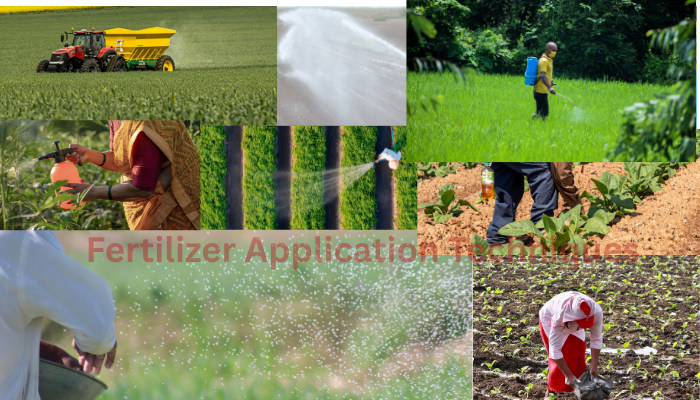
1. Broadcasting Fertilizer Application Technique
In this method, fertilizers are uniformly spread over the entire field surface manually or mechanically.
- Advantages: Simple and fast, suitable for close-growing crops like wheat and rice.
- Disadvantages: High nutrient loss due to runoff, volatilization, and uneven distribution.
2. Placement Method of Fertilizer Application
Fertilizers are placed near the root zone, improving nutrient use efficiency.
- Types: Deep placement, band placement, side dressing.
- Benefits: Reduces nutrient loss and ensures better crop uptake.
3. Fertigation Fertilizer Application Technique
This method delivers fertilizers through irrigation systems like drip or sprinkler irrigation.
- Advantages: Precise delivery, saves water, and increases nutrient efficiency.
- Used for: High-value crops like vegetables, fruits, and flowers.
4. Foliar Fertilizer Application Method
Nutrients are sprayed directly onto leaves and absorbed through stomata.
- Used for: Quick correction of micronutrient deficiencies.
- Limitations: Cannot supply large amounts of macronutrients.
5. Controlled & Slow Release Fertilizer Application Techniques
These fertilizers release nutrients gradually, reducing application frequency and losses.
Quiz: Test Your Understanding
1. Which fertilizer technique is most precise and water-efficient?
A) Broadcasting
B) Fertigation
C) Foliar Application
D) Band Placement
Answer: B
Explanation: Fertigation integrates irrigation with fertilization, ensuring precise delivery.
2. What is the main limitation of foliar application?
A) High cost
B) Not suitable for micronutrients
C) Ineffective at low temperatures
D) Cannot supply large quantities of nutrients
Answer: D
Explanation: Foliar spraying is effective for micronutrients but not for bulk macronutrients like nitrogen.
3. Which method places fertilizer close to plant roots?
A) Broadcasting
B) Top dressing
C) Placement
D) Spraying
Answer: C
Explanation: Placement ensures fertilizer is delivered near active roots for better absorption.
4. Controlled release fertilizers help in:
A) Faster absorption
B) Reducing application frequency
C) Increasing soil acidity
D) Decreasing root growth
Answer: B
Explanation: They release nutrients slowly, reducing the number of applications needed.
FAQs on Fertilizer Application Techniques
Q1. Which fertilizer application technique is best for rice?
Placement and broadcasting are common, but deep placement ensures higher efficiency in rice fields.
Q2. Is fertigation suitable for all crops?
No. It is mainly used for high-value crops like fruits, vegetables, and flowers where drip or sprinkler irrigation is available.
Q3. How do slow-release fertilizers help the environment?
They reduce nutrient leaching and volatilization, thus minimizing groundwater pollution and greenhouse gas emissions.
Related Resources
