
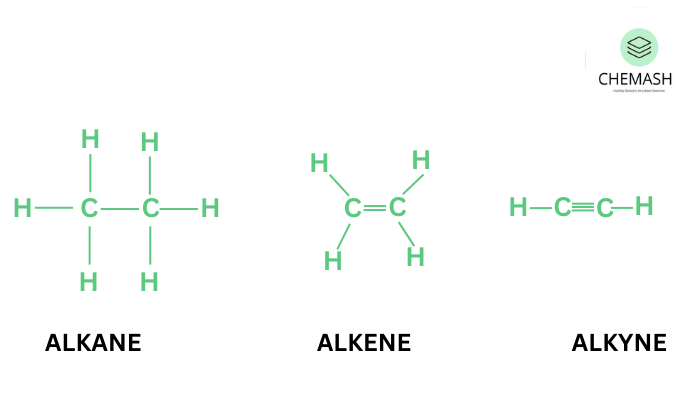
Hydrocarbons are classified into different types based on the bonding between carbon atoms. Each type follows a general formula that represents the relationship between carbon (C) and hydrogen (H) atoms.
1. Alkanes (Saturated Hydrocarbons)
Alkanes contain only single bonds (C–C) and are also known as paraffins.
- General Formula: CnH2n+2
- Example: Methane (CH₄), Ethane (C₂H₆), Propane (C₃H₈)
2. Alkenes (Unsaturated Hydrocarbons)
Alkenes contain at least one double bond (C=C) in their structure.
- General Formula: CnH2n
- Example: Ethene (C₂H₄), Propene (C₃H₆), Butene (C₄H₈)
3. Alkynes (Unsaturated Hydrocarbons)
Alkynes contain at least one triple bond (C≡C).
- General Formula: CnH2n−2
- Example: Ethyne (C₂H₂), Propyne (C₃H₄), Butyne (C₄H₆)
4. Cycloalkanes
These are ring-shaped saturated hydrocarbons with only single bonds.
- General Formula: CnH2n
- Example: Cyclopropane (C₃H₆), Cyclobutane (C₄H₈)
5. Aromatic Hydrocarbons
Aromatic hydrocarbons (arenes) contain one or more benzene rings and follow Hückel’s Rule.
- General Formula: CnH2n−6 (for monocyclic aromatics like benzene)
- Example: Benzene (C₆H₆), Toluene (C₇H₈), Naphthalene (C₁₀H₈)
Quick Summary Table
| Type | Bonding | General Formula | Example |
|---|---|---|---|
| Alkanes | Single bonds | CnH2n+2 | CH₄, C₂H₆ |
| Alkenes | Double bond | CnH2n | C₂H₄, C₃H₆ |
| Alkynes | Triple bond | CnH2n−2 | C₂H₂, C₃H₄ |
| Cycloalkanes | Ring, single bonds | CnH2n | C₃H₆, C₄H₈ |
| Aromatics | Conjugated π bonds | CnH2n−6 | C₆H₆, C₇H₈ |
Key Point
Each class of hydrocarbons has its own general formula, which helps predict molecular composition, chemical reactivity, and possible structural isomers.
