
Greenhouse Effect
What Is the Greenhouse Effect?
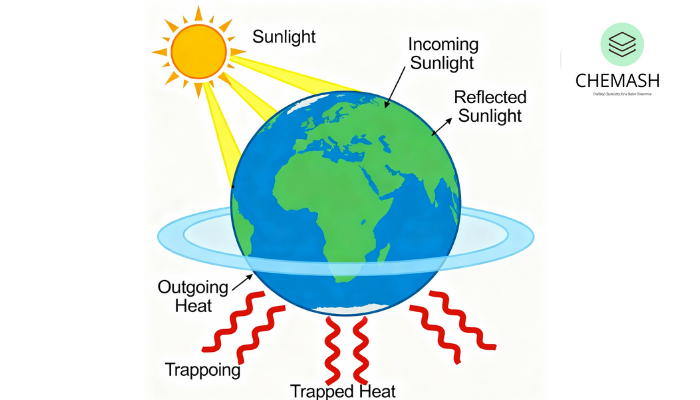
The greenhouse effect keeps Earth warm enough to support life. It happens when gases in the atmosphere trap heat radiated by Earth’s surface. Sunlight passes through the air, warms the ground, and the surface releases heat energy. Greenhouse gases absorb some of this energy and send it back, creating a balance that maintains a livable temperature.
Without this process, our planet’s average temperature would fall to around –18°C instead of the comfortable +15°C we experience today. Therefore, the greenhouse effect acts like a natural thermal blanket that protects life on Earth.
Key Greenhouse Gases
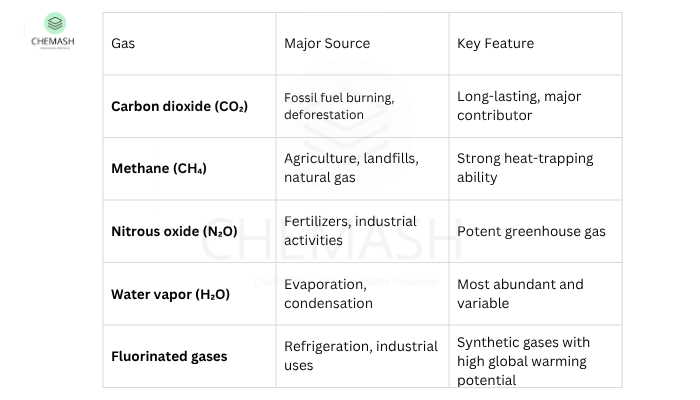
| Gas | Major Source | Key Feature |
|---|---|---|
| Carbon dioxide (CO₂) | Burning fossil fuels, deforestation | Main contributor to warming |
| Methane (CH₄) | Agriculture, landfills, natural gas | Stronger heat-trapping ability than CO₂ |
| Nitrous oxide (N₂O) | Fertilizers, industrial activity | Powerful long-lived greenhouse gas |
| Water vapor (H₂O) | Evaporation, condensation | Most abundant greenhouse gas |
| Fluorinated gases | Refrigeration, industry | Man-made gases with high global warming potential |
Human Impact and Global Warming
Since the Industrial Revolution, human actions have greatly increased the amount of greenhouse gases in the atmosphere. As a result, the natural greenhouse effect has become stronger, causing global warming.
This change leads to higher global temperatures, melting ice caps, rising sea levels, and unpredictable weather. Moreover, ecosystems face stress, and extreme events occur more frequently. To prevent further damage, people must reduce emissions and switch to cleaner energy sources.
Quiz
1️⃣ What is the main cause of the enhanced greenhouse effect?
Answer: Deforestation and fossil fuel burning.
Explanation: These activities increase CO₂ levels, which trap more heat and raise global temperatures.
2️⃣ Which greenhouse gas is most abundant in the atmosphere?
Answer: Water vapor.
Explanation: Water vapor naturally cycles through the air and contributes most to the natural greenhouse effects.
3️⃣ Without the greenhouse effect, what would Earth’s average temperature be?
Answer: –18°C.
Explanation: The greenhouse effects keeps our planet about 33°C warmer than it would otherwise be.
4️⃣ Which gas is NOT a greenhouse gas?
Answer: Oxygen.
Explanation: Oxygen does not absorb infrared radiation and therefore does not trap heat.
Frequently Asked Questions
Q1. Is the greenhouse effect entirely bad?
No. The natural greenhouse effect is necessary for life on Earth. However, human activities enhance it, leading to harmful climate changes.
Q2. How can we reduce human-caused emissions?
We can use renewable energy, improve energy efficiency, protect forests, and cut methane emissions from agriculture and waste.
Q3. Does water vapor cause global warming?
Water vapor strengthens warming through feedback loops, but its amount depends on temperature. Therefore, reducing CO₂ and other long-lived gases helps limit overall warming.
Up Next: Global Warming and Climate Change
Published by CHEMASH — Updated: October 12, 2025
