
Group 1: Alkali Metals
Group 1 elements, known as the alkali metals, include Li, Na, K, Rb, Cs, and Fr. They possess the outer electronic configuration ns¹. Consequently, they are highly reactive, particularly with water, and they easily form +1 cations. In addition, alkali metals are soft, have relatively low melting points, and act as strong reducing agents.
Electronic Configuration & General Properties of Alkali Metals
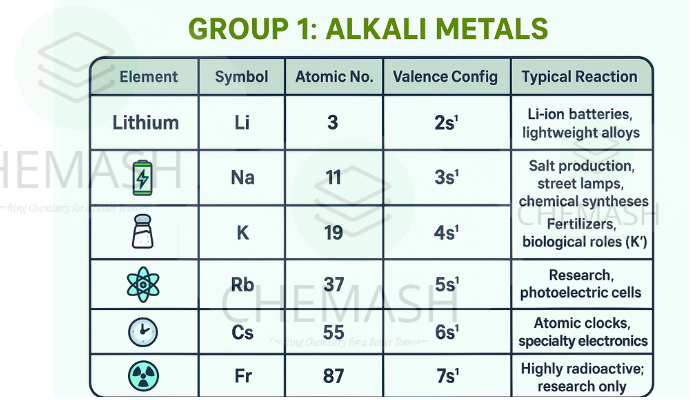
All alkali metals share the valence configuration ns¹ (where n = period number). This single valence electron explains their distinctive features: low ionization energy, strong metallic character, and high reactivity. Moreover, their tendency to form stable M+ ions increases as we move down the group.
Quick Reference Table of Alkali Metals
| Element | Symbol | Atomic No. | Valence Config | Typical Reaction / Use |
|---|---|---|---|---|
| Lithium | Li | 3 | 2s¹ | Li-ion batteries, lightweight alloys |
| Sodium | Na | 11 | 3s¹ | Salt production, street lamps, chemical syntheses |
| Potassium | K | 19 | 4s¹ | Fertilizers, biological roles (K⁺) |
| Rubidium | Rb | 37 | 5s¹ | Research, photoelectric cells |
| Cesium | Cs | 55 | 6s¹ | Atomic clocks, specialty electronics |
| Francium | Fr | 87 | 7s¹ | Extremely radioactive; studied only in research |
Chemical Behaviour & Reactions of Alkali Metals
- With water: They react vigorously → M + H₂O → MOH + ½H₂ (e.g.,
2Na + 2H₂O → 2NaOH + H₂). - With oxygen: They form oxides, peroxides, or superoxides depending on the element and conditions.
- With halogens: They combine directly to give ionic halides (e.g., NaCl).
- Reducing agents: Because they donate their outer electron easily, alkali metals act as powerful reducing agents.
Periodic Trends in Alkali Metals
- Reactivity steadily increases down the group (Li < Na < K < Rb < Cs < Fr).
- Atomic and ionic radii expand, while ionization energy decreases.
- Melting and boiling points generally fall; meanwhile, densities usually rise with some anomalies.
Applications of Alkali Metals
- Lithium: Rechargeable batteries, lightweight alloys.
- Sodium: Industrial chemicals, Na vapor lamps for street lighting.
- Potassium: Essential fertilizers, biological electrolytes.
- Rubidium & Cesium: Atomic clocks, advanced research, photoelectric cells.
Safety & Handling of Alkali Metals
Alkali metals react violently with water; therefore, they must be stored under mineral oil or in an inert atmosphere. Always use non-sparking tools, wear proper PPE, and follow strict safety protocols. Scientists only study francium in trace amounts because it is highly radioactive.
MCQs: Test Your Understanding of Alkali Metals
- What is the general electronic configuration of alkali metals?
Answer:ns¹ - Which alkali metal shows the highest reactivity?
Answer: Cesium (Cs), while francium is predicted to be more reactive but remains rare and radioactive. - What are the products when sodium reacts with water?
Answer: Sodium hydroxide (NaOH) and hydrogen gas (H₂). - Why should alkali metals be stored under oil?
Answer: Because oil prevents contact with air or moisture, which would otherwise trigger violent reactions.
FAQs on Alkali Metals
Q: Why does reactivity increase down Group 1?
A: The outer electron lies farther from the nucleus and experiences stronger shielding, so it is removed more easily.
Q: Can alkali metals exist freely in nature?
A: No. Because they are highly reactive, alkali metals only occur as stable compounds (salts) in nature.
Q: Which alkali metal is mainly used in batteries?
A: Lithium is widely used in modern rechargeable batteries (Li-ion cells).

Pingback: Group 2: Alkaline Earth Metals - CHEMASH