
Hückel’s Rule (ह्यूकेल का नियम)
Short summary: Hückel’s Rule is a simple criterion for aromaticity: a planar, cyclic, fully conjugated π-system is aromatic if it has (4n + 2) π electrons (n = 0,1,2…).
ह्यूकेल का नियम कहता है कि यदि कोई चक्रीय, समतल, पूरी तरह सहसंयोजित (conjugated) π-सिस्टम में (4n+2) π-इलेक्ट्रॉन्स हों तो वह सुगंधीय (aromatic) होता है।
Why Hückel’s Rule matters (क्यों महत्वपूर्ण)
It predicts whether cyclic conjugated molecules are unusually stable (aromatic) or unusually unstable (antiaromatic). This explains reactivity patterns, spectroscopy, and many properties of organic molecules.
यह चक्रीय समसंयोजित अणुओं की असामान्य स्थिरता या अस्थिरता की भविष्यवाणी करता है, और प्रतिक्रियाशीलता तथा गुणों की व्याख्या में सहायता करता है।
Conditions for applying Hückel’s Rule
- System must be cyclic (closed loop). (चक्रीय)
- Conjugation around the ring: every atom in the ring must have a p orbital (fully conjugated). (पूरी तरह सहसंयोजित)
- The ring must be planar (or effectively planar) so p orbitals overlap. (समतल)
- Electron count: π electrons = (4n + 2) for aromatic; 4n often gives antiaromaticity. (इलेक्ट्रॉन गणना)
Quick derivation / physical idea (संक्षिप्त व्युत्पत्ति)
Hückel molecular orbital (HMO) theory treats π electrons in a cyclic conjugated system as particles in a polygonal ring. Energy levels form sets; when bonding orbitals are completely filled and antibonding remain empty, the system gains extra stability. Filling occurs when total π electrons = 4n+2 (closed shell of bonding MOs).
HMO सिद्धांत में π इलेक्ट्रॉनों को एक बहुभुजाकार रिंग में होते हुए माना जाता है — यदि बंधनात्मक ऑर्बिटल पूरी तरह भरे हों और अपबंधनात्मक खाली हों तो अतिरिक्त स्थिरता मिलती है, जो 4n+2 इलेक्ट्रॉन्स पर पूरी होती है।
Common examples (उदाहरण)
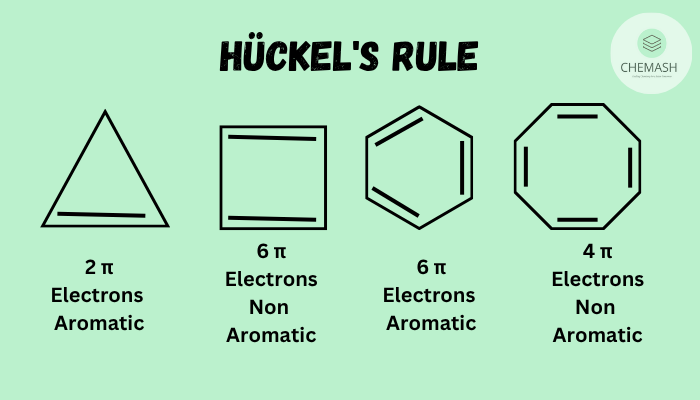
Benzene
6 π electrons → fits 4n+2 with n=1 → aromatic. Shows equal bond lengths, high stability, characteristic NMR signals.
Cyclobutadiene
4 π electrons → fits 4n (n=1) → antiaromatic (unstable, reactive). In practice it distorts or dimerizes to avoid antiaromaticity.
Other examples & annulenes
- [10]Annulene with 10 π electrons (n=2) can be aromatic if planar and steric permits conjugation.
- Heterocycles: pyrrole, furan, thiophene have 6 π electrons (including lone pairs as needed) and are aromatic by Hückel rules.
Important exceptions & caveats (अपवाद)
- Planarity is essential — large annulenes may not be planar, so Hückel count alone is insufficient.
- Transition metals and Möbius aromaticity are special cases (Möbius systems follow 4n rule for aromaticity when twisted).
- Hückel’s Rule is a rule of thumb derived from HMO; high-level quantum calculations sometimes refine predictions.
Visual checklist for students
- Is the structure cyclic?
- Is the ring fully conjugated? (every atom in ring has p orbital)
- Is it planar (or can it adopt a planar conformation)?
- Count π electrons (double bond = 2 each; lone pairs may contribute 2 if they are in p orbitals and part of conjugation).
- Apply 4n+2 test: if yes → aromatic; if 4n → antiaromatic; else → nonaromatic.
Practice — MCQs, True/False, Fill-ups, Matching (with answers & explanation)
MCQs
- Which electron count satisfies Hückel’s rule for aromaticity?
A) 4
B) 6
C) 8
D) 10
Answer: B (6) and D (10) — both satisfy 4n+2 (n=1 → 6; n=2 → 10). Explanation: numbers that fit 4n+2 are aromatic counts (2,6,10,14…). - Which statement is TRUE about cyclobutadiene?
A) It is aromatic.
B) It is antiaromatic.
C) It is nonaromatic and stable.
D) It always obeys planarity.
Answer: B — Cyclobutadiene (4 π electrons) is antiaromatic (very unstable) and usually distorts to avoid antiaromaticity. - Pyrrole is aromatic because:
A) It has 4 π electrons
B) All N lone pairs participate in π system
C) One lone pair of N contributes to π system giving 6 π electrons
D) It is antiaromatic
Answer: C — In pyrrole, one of the nitrogen lone pairs is in the p orbital contributing 2 π electrons; total 6 π electrons → aromatic.
True / False
- TF: Hückel’s rule requires the molecule to be planar. → True
- TF: Every 4n+2 electron system is aromatic regardless of geometry. → False (must be planar and conjugated)
Fill in the blanks
- Hückel’s rule formula is ______. → 4n + 2
- Benzene has ______ π electrons. → 6
Matching
| Compound | Category |
|---|---|
| Benzene | → Aromatic (4n+2, n=1) |
| Cyclobutadiene | → Antiaromatic (4n, n=1) |
| Pyrrole | → Aromatic (lone pair contributes) |
Short explanations (quick)
Why 4n+2? The orbital diagram for a cyclic conjugated system places energy levels such that closed filling of bonding orbitals occurs when π electrons equal 4n+2; this gives a closed shell and extra stabilization.
FAQs (सामान्य प्रश्न)
Q: Can non-carbon atoms contribute to the π count?
A: Yes — heteroatoms (N, O, S) may contribute lone pairs to the conjugated π system if the lone pair is in a p orbital aligned with the ring.
Q: What is antiaromaticity?
A: Systems with 4n π electrons that are planar and fully conjugated experience destabilization and high reactivity (antiaromatic).
Q: Are there aromatic systems that don’t follow Hückel?
A: Möbius aromatic systems (twisted topology) follow different rules (4n rather than 4n+2) — they are special, less common cases.
Author: CHEMASH • Updated: Nov 2025
