
Hückel’s Rule – Aromaticity and the 4n + 2 π Electron Rule
Hückel’s Rule helps identify whether a ring system is aromatic, antiaromatic, or non-aromatic. Aromatic compounds are especially stable and play a key role in organic chemistry.
Contents
Definition
Hückel’s Rule states:
For a ring to be aromatic:
π electrons = 4n + 2 (n = 0, 1, 2…)
Aromatic systems must also be:
- Planar
- Cyclic
- Fully conjugated
Why the 4n + 2 Rule Works
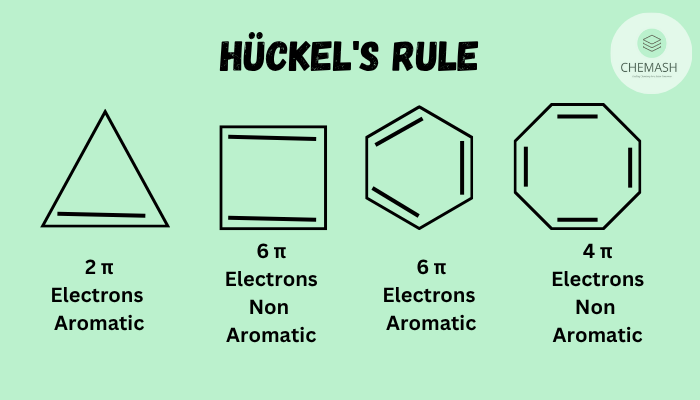
In cyclic conjugated molecules, π electrons occupy molecular orbitals. When the total electron count equals 4n + 2, all bonding orbitals are filled, giving a closed-shell, stable system.
Exam tip: For benzene, 6 π electrons fill 3 bonding orbitals → extra stability.
Examples
- Benzene (C₆H₆) – 6 π electrons → aromatic
- Cyclobutadiene (C₄H₄) – 4 π electrons → antiaromatic
- Cyclooctatetraene (C₈H₈) – 8 π electrons → non-aromatic (non-planar)
- Cyclopropenyl cation – 2 π electrons → aromatic
- Pyrrole, furan, pyridine – lone pairs contribute differently
Exceptions & Limitations
- Ring must be planar (else rule doesn’t apply)
- Requires continuous conjugation
- Heterocycles: check which lone pair enters the π system
- Large rings → obey different rules (Möbius, spherical aromaticity)
Applications
Hückel’s Rule is essential to understand:
- Reactivity of aromatic compounds
- NMR shifts from ring current effects
- Stability of organic molecules
- Design of conducting polymers & organic semiconductors
FAQ
How do I count π electrons?
Each double bond contributes 2 π electrons. Lone pairs contribute only if aligned with the ring’s p-orbitals.
Is Hückel’s Rule always correct?
No. It is reliable for small, planar molecules. Larger systems may need advanced MO theory.
IoT MCQs (Internet of Things)
1. What does IoT mainly connect?
A) Only computers
B) Devices and sensors to the internet
C) Only smartphones
D) Only smart TVs
Answer: B
2. Which protocol is widely used in IoT communication?
A) HTTP
B) SMTP
C) MQTT
D) FTP
Answer: C
3. Which of the following is an IoT hardware platform?
A) Arduino
B) Google Docs
C) MS Word
D) VLC Player
Answer: A
4. Which wireless technology is MOST used for smart home devices?
A) Zigbee
B) VGA
C) USB
D) HDMI
Answer: A
5. A smart watch sending your heart rate to your phone uses:
A) Bluetooth
B) HDMI
C) DNS
D) SMTP
Answer: A
Quick IoT Quiz
Quiz: Identify True or False
1. IoT devices can work without sensors.
False — sensors are a core part of IoT data collection.
2. MQTT is more lightweight than HTTP.
True — MQTT is optimized for low-power IoT devices.
3. Arduino is only used for software applications.
False — Arduino is a hardware microcontroller platform.
4. Smart agriculture systems use IoT.
True — moisture sensors, weather nodes, etc.
5. All IoT devices require high bandwidth internet.
False — many work on low-bandwidth LPWAN networks.
Useful Outbound Links (High Authority)
- Khan Academy – Organic Chemistry
- ChemGuide – Aromaticity
- Britannica – Aromatic Compounds
- ScienceDirect – Aromaticity Research
- IoT For All – Internet of Things Education
© CHEMASH — Educational Organic Chemistry Content
