
Human Circulatory System – CHEMASH Biology
The Human Circulatory System is responsible for transporting oxygen, nutrients, hormones and waste products throughout the body. This chapter is highly important for Boards & NEET 2026.
Related Topics: Breathing & Respiration | Human Digestive System
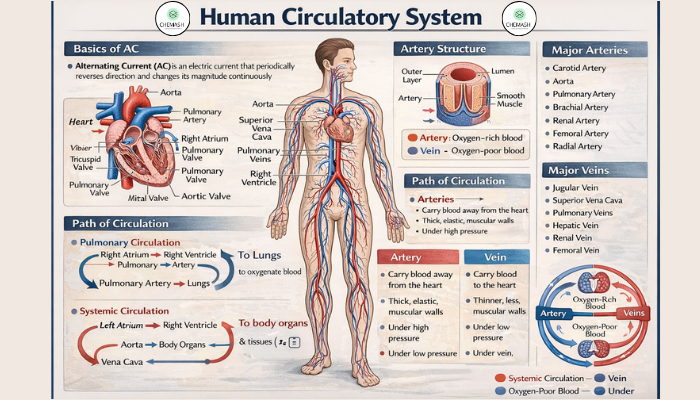
Table of Contents
Structure of Human Heart
The human heart is a muscular organ located in the chest cavity. It has four chambers:
- Right Atrium
- Right Ventricle
- Left Atrium
- Left Ventricle
1️⃣ Right Atrium
- Receives deoxygenated blood from the body.
- Blood enters through the superior and inferior vena cava.
- Passes blood to right ventricle through the tricuspid valve.
2️⃣ Right Ventricle
- Pumps deoxygenated blood to the lungs.
- Blood leaves through the pulmonary artery.
- Contains pulmonary semilunar valve to prevent backflow.
3️⃣ Left Atrium
- Receives oxygenated blood from lungs.
- Blood enters through pulmonary veins.
- Transfers blood to left ventricle through bicuspid (mitral) valve.
4️⃣ Left Ventricle
- Pumps oxygenated blood to entire body.
- Blood leaves through the aorta.
- Has the thickest muscular wall.
Why is Left Ventricle Thickest?
Because it pumps blood to the entire body at high pressure. It must generate more force compared to right ventricle, which only pumps blood to nearby lungs.
Components of Blood
| Component | Function |
|---|---|
| RBC (Red Blood Cells) | Transport oxygen (Hemoglobin) |
| WBC (White Blood Cells) | Fight infections |
| Platelets | Blood clotting |
| Plasma | Liquid medium of blood |
Blood Vessels
- Arteries: Carry blood away from heart
- Veins: Carry blood toward heart
- Capillaries: Exchange of gases and nutrients
Double Circulation
In humans, blood passes through the heart twice in one complete cycle.
- Pulmonary circulation (Heart ↔ Lungs)
- Systemic circulation (Heart ↔ Body)
Advantage: Prevents mixing of oxygenated and deoxygenated blood.
Common Circulatory Disorders
- Hypertension (High BP)
- Heart Attack
- Anemia
- Atherosclerosis
MCQs (NEET 2026 Oriented)
1. Thickest chamber of heart:
Answer: Left ventricle
2. Blood clotting is done by:
Answer: Platelets
3. Double circulation is found in:
Answer: Humans
4. Oxygen transport is done by:
Answer: Hemoglobin
FAQs
Q1. Why is left ventricle thicker?
A: It pumps blood to entire body.
Q2. What is plasma?
A: Liquid part of blood.
Official reference: NCERT Biology Textbook
Study with CHEMASH
CHEMASH provides affordable tuition for all classes (Biology, Chemistry & Physics). Experienced teachers, concept clarity, problem-solving sessions and weekly tests for Boards & NEET 2026. Trusted and helpful learning platform. Join CHEMASH Classes
