
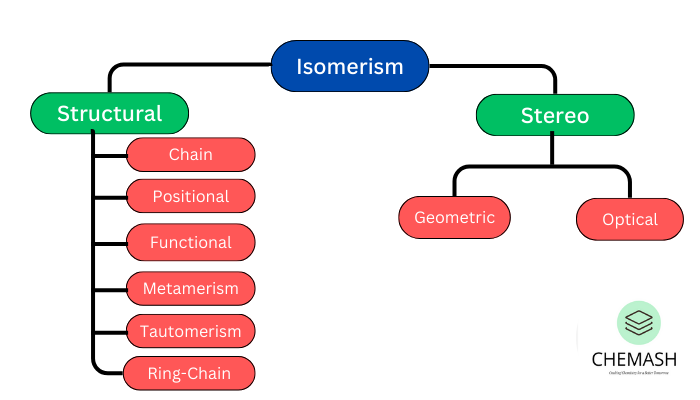
Isomerism is the phenomenon where two or more compounds have the same molecular formula but different structural or spatial arrangements of atoms. These compounds are called isomers.
Isomerism is broadly classified into:
- Structural (or Constitutional) Isomerism
- Stereoisomerism
Structural Isomerism
Occurs when isomers differ in the connectivity of atoms within the molecule.
Types of Structural Isomerism:
- Chain Isomerism: Different carbon skeletons.
Example: C₄H₁₀ → Butane & Isobutane - Position Isomerism: Same functional group, different position.
Example: C₃H₇OH → 1-propanol & 2-propanol - Functional Isomerism: Different functional groups.
Example: C₂H₆O → Ethanol (alcohol) & Dimethyl ether (ether) - Metamerism: Different alkyl groups on either side of a functional group.
Example: C₄H₁₀O → Ethoxyethane & Methoxypropane - Tautomerism: Dynamic equilibrium between two isomers.
Example: Keto-enol tautomerism in acetone.
Stereoisomerism
Occurs when atoms are connected in the same sequence but differ in their spatial arrangement.
Types of Stereoisomerism:
- Geometrical Isomerism (cis-trans or E/Z): Restricted rotation.
Example: But-2-ene → cis & trans forms - Optical Isomerism: Involves chiral molecules.
- Enantiomers: Mirror images
- Diastereomers: Not mirror images
- Meso compounds: Optically inactive due to symmetry
Summary Table
| Type | Sub-type | Example | Key Feature |
|---|---|---|---|
| Structural | Chain | Butane vs Isobutane | Different carbon chain |
| Position | 1-propanol vs 2-propanol | Same group, different location | |
| Functional | Ethanol vs Dimethyl ether | Different functional groups | |
| Metamerism | Ethoxyethane vs Methoxypropane | Different alkyl groups | |
| Tautomerism | Keto ↔ Enol | Dynamic equilibrium | |
| Stereoisomerism | Geometrical | cis/trans But-2-ene | Arrangement across double bond |
| Optical | (+)-Lactic acid vs (−)-Lactic acid | Mirror image behavior |
Quiz: Isomerism in Organic Chemistry
1. Which is chain isomerism?
B. Butane & Isobutane ✅
2. Same formula but different functional groups?
C. Functional Isomers ✅
3. Geometrical isomerism not possible in?
C. Alkanes ✅
4. Which pair is enantiomers?
C. (+) & (−)-Lactic acid ✅
5. CH₃CH(OH)CH₃ shows?
C. Optical isomerism ✅
6. Differ in spatial arrangement only?
B. Stereoisomers ✅
7. Optically inactive due to symmetry?
B. Meso compounds ✅
Extra Practice
True/False
- All structural isomers have the same connectivity. ❌
- Geometrical isomers occur in alkenes. ✅
- Meso compounds are optically inactive. ✅
Fill in the blanks
- Isomers with same formula but different functional groups are called ________. (Functional isomers)
- Compounds with restricted rotation show ________ isomerism. (Geometrical)
Match the following
| Column A | Column B |
|---|---|
| Butane & Isobutane | Chain Isomerism |
| Ethanol & Dimethyl Ether | Functional Isomerism |
| cis & trans But-2-ene | Geometrical Isomerism |
| (+)- & (−)-Lactic acid | Optical Isomerism |
FAQs on Isomerism
Q1: What is isomerism?
A1: Compounds with same molecular formula but different structures.
Q2: What are the two main types of isomerism?
A2: Structural and Stereoisomerism.
Q3: Give an example of functional isomerism.
A3: Ethanol and Dimethyl ether (C₂H₆O).
Isomerism explains why same formula compounds behave differently!
IUPAC Nomenclature in Organic Chemistry |
