
What are Kinematic Equations?
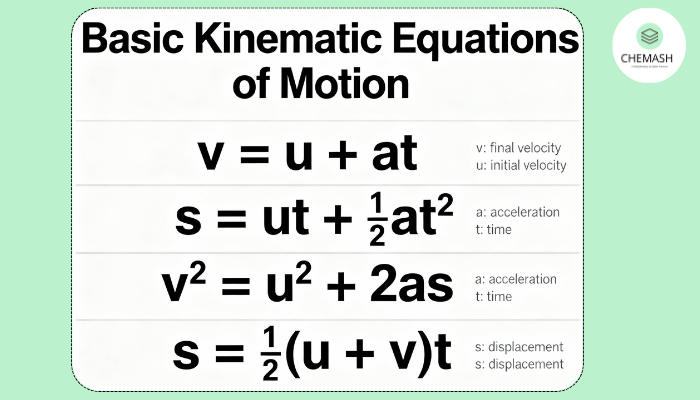
Kinematic equations describe the motion of objects moving with constant acceleration. They relate displacement (s), initial velocity (u), final velocity (v), acceleration (a), and time (t). These are often called the SUVAT equations in many syllabuses.
4 Standard Kinematic Equations (for constant acceleration)
- v = u + a t — final velocity after time t.
- s = u t + 1/2 a t² — displacement after time t.
- v² = u² + 2 a s — relates velocities and displacement (no time).
- s = (u + v)/2 × t — displacement using average velocity.
Variable notes: u = initial velocity, v = final velocity, a = constant acceleration, t = time, s = displacement.
Derivations (concise)
1. From definition of acceleration
Acceleration: a = (v - u) / t. Rearranging gives v = u + a t.
2. Displacement using average velocity
Average velocity when acceleration is constant: (u + v)/2. So s = ((u + v)/2) × t.
3. Using v = u + a t in s = u t + 1/2 a t²
Substitute t = (v - u)/a into s = u t + 1/2 a t² to derive v² = u² + 2 a s.
Worked Example 1 — Straightforward
Problem: A car starts from rest and accelerates at 2 m/s² for 5 s. Find final velocity and displacement.
Solution:
- Given:
u = 0,a = 2 m/s²,t = 5 s. - Final velocity:
v = u + a t = 0 + 2 × 5 = 10 m/s. - Displacement:
s = u t + 1/2 a t² = 0 + 0.5 × 2 × 25 = 25 m.
Worked Example 2 — Using v² = u² + 2 a s
Problem: A ball thrown upward with initial speed u = 20 m/s slows under gravity a = -9.8 m/s². What is the maximum height reached?
Solution: At maximum height v = 0. Use 0 = u² + 2 a s → s = -u²/(2a). Numerically: s = -(20²)/(2 × -9.8) = 400/19.6 ≈ 20.41 m.
Quick Tips & Problem Strategy
- Identify known variables first (u, v, a, t, s).
- Pick the equation that does not include the unknown variable you don’t have.
- Watch signs for vector quantities (up/down or left/right).
- Use
v² = u² + 2 a swhen time is not provided.
Practice MCQs (click to reveal answer)
1) A car moves with constant acceleration 3 m/s². If its initial speed is 4 m/s, what is its speed after 2 s?
Answer: v = u + a t = 4 + 3×2 = 10 m/s 2) A particle with initial speed 10 m/s decelerates at 5 m/s².
What distance does it travel before stopping?
Answer: Use v² = u² + 2 a s with v=0: s = -u²/(2a) = -(10²)/(2×-5)=100/10=10 m.
Common Mistakes
- Mixing up
vandu. Label clearly. - Forgetting negative sign for acceleration when motion opposes velocity.
- Using average velocity formula only when acceleration is constant.
Frequently Asked Questions (FAQ)
Do kinematic equations work for variable acceleration?
No — these 4 equations assume constant acceleration. For variable acceleration, use calculus: a = dv/dt and v = ds/dt.
Which equation should I use if time is unknown?
Use v² = u² + 2 a s because it does not include t.
If you want a printable PDF or Hindi translation, request it on the contact page.
Clear, exam-ready summary • Includes derivations, examples & practice questions
