
Manufacturing Process of Cement
Cement plays a vital role in construction. The process of making cement begins with limestone, clay, and sand. Manufacturers heat these raw materials at high temperatures, convert them into clinker, and then grind the clinker with gypsum to produce cement powder. In this article, you will learn the complete step-by-step process.Manufacturing Process of Cement
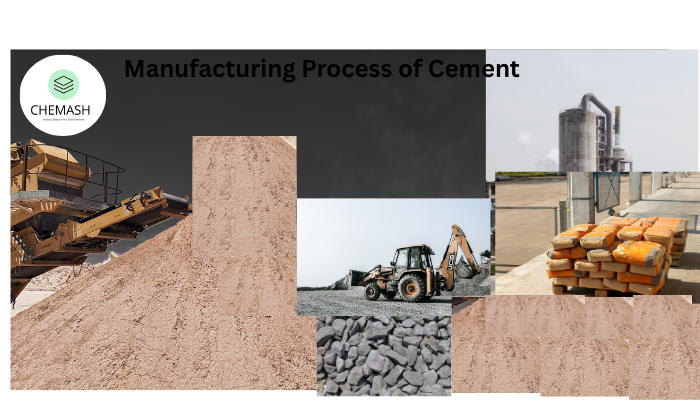
1. Quarrying and Crushing
Workers extract raw materials such as limestone and clay from quarries. They crush these materials into smaller pieces to make handling easier. Moreover, crushing ensures uniform particle size for further processing.
2. Proportioning and Grinding
Technicians carefully proportion the crushed materials according to the required chemical composition. Afterward, machines grind them into a fine powder called raw meal. This step guarantees consistency in the final cement quality.
3. Blending and Homogenizing
The raw meal goes through blending units, where mixers homogenize it to achieve uniformity. As a result, the mixture maintains a balanced composition before entering the kiln.
4. Preheating
Hot gases from the kiln preheat the raw meal. This step initiates partial decomposition, reduces moisture, and saves energy before the material enters the rotary kiln.
5. Clinkerization in Rotary Kiln
The preheated raw meal enters a rotary kiln, where the temperature reaches nearly 1450°C. At this stage, chemical reactions occur, and clinker nodules form. These nodules are small, dark gray, and serve as the core ingredient for cement.
6. Cooling
The hot clinker leaves the kiln and passes through coolers. Rapid cooling preserves the mineral structure and ensures high cement quality. Therefore, this step directly influences cement performance.
7. Grinding
Next, manufacturers mix the cooled clinker with a small quantity of gypsum. They grind this mixture into fine cement powder. Gypsum slows down the setting time, allowing builders to use cement effectively.
8. Packaging and Storage
Finally, the cement moves into silos for storage. Later, workers pack it into bags or transport it in bulk. This ensures safe distribution to markets and construction sites.
Quiz: Cement Manufacturing Process
- Which raw material is the primary ingredient in cement?
- What do we call the fine powder before heating in the kiln?
- At what temperature does clinkerization occur?
- Why do manufacturers add gypsum during grinding?
- How does preheating improve the process?
Answers
- Limestone
- Raw meal
- About 1450°C
- It controls the setting time of cement.
- It reduces energy use and starts decomposition.
Fill in the Blanks
1. The rotary kiln operates at nearly ______ °C. (Answer: 1450)
2. ______ is mixed with clinker during grinding to regulate setting time. (Answer: Gypsum)
3. The fine powder prepared before the kiln is called ______. (Answer: Raw meal)
FAQs
Q1. What is clinker?
Clinker consists of small nodules formed during the heating of raw meal at high temperatures in the kiln. It serves as the main component of cement.
Q2. Why do we use gypsum in cement?
Gypsum prevents flash setting by controlling how fast cement hardens. Therefore, it gives engineers more time to use the mixture.
Q3. How does cement differ from concrete?
Cement is a binding material, whereas concrete is a mixture of cement, sand, aggregates, and water.
Learn more about environmental impacts of cement on our site. For deeper insights, visit International Cement Review.

Pingback: Properties and Testing of Cement - CHEMASH
Pingback: Types of Cement - CHEMASH
Pingback: Raw Materials for Cement Production