
Ohm’s Law — Definition, Formula, Proof, Examples & Applications
A complete, exam-ready guide to Ohm’s Law with worked problems, common pitfalls, and a quiz + answers.
Quick fact:Ohm’s Law relates voltage (V), current (I) and resistance (R) in many electrical circuits: V = I × R. This page covers the formula, derivation, units, examples, graph interpretation, applications and FAQ.
- Definition & Formula
- Derivation / Proof
- Units & Notation
- Worked Examples
- V–I Graphs & Interpretation
- Applications
- Limitations
- FAQ
- Quiz (with answers)
What is Ohm’s Law?
Ohm’s Law is a fundamental relationship in electrical circuits that states: the current through a conductor between two points is directly proportional to the voltage across the two points, provided the physical conditions (such as temperature) remain constant. In equation form:
V = I × R
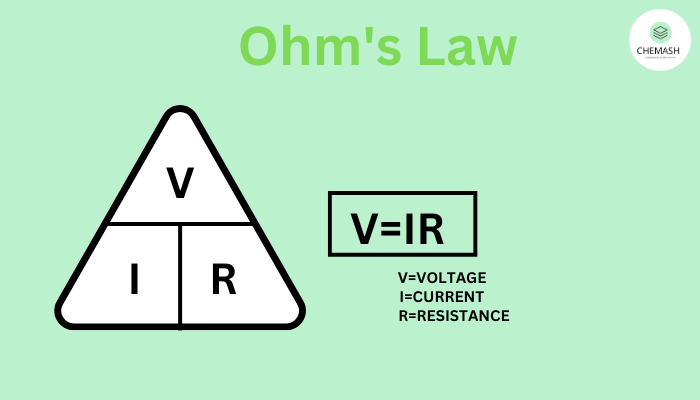
- V = Voltage (potential difference) across the component
- I = Current through the component
- R = Resistance of the component
Derivation & physical idea
Ohm’s Law is empirical — it was established by observing many conductors under steady conditions (Georg Simon Ohm, 1827). Microscopically, when an electric field is applied, charge carriers (electrons in metals) drift with average drift velocity proportional to the field; the ratio of field to drift velocity determines resistivity and yields a linear V–I relation for ohmic materials.
Algebraic manipulation
From V = I × R, you can write:
- I = V / R — current for given voltage and resistance
- R = V / I — resistance measured by voltage/current
Units & common symbols
| Quantity | Symbol | SI Unit |
|---|---|---|
| Voltage (potential difference) | V | Volt (V) |
| Current | I | Ampere (A) |
| Resistance | R | Ohm (Ω) |
Note: 1 Ω = 1 V / 1 A.
Worked examples (step-by-step)
Example 1 — Find current
A resistor of 100 Ω is connected across a 12 V battery. Find the current.
Solution:
- Use Ohm’s Law: I = V / R
- Substitute values: I = 12 V / 100 Ω = 0.12 A
Answer: 0.12 A (or 120 mA)
Example 2 — Find resistance
A lamp draws 0.5 A from a 230 V mains supply. What is the resistance of the lamp (approx.)?
Solution:
- R = V / I
- R = 230 V / 0.5 A = 460 Ω
Answer: 460 Ω
Example 3 — Series circuit
Two resistors, 50 Ω and 100 Ω, are connected in series across 24 V. Find total current.
- Total R = 50 + 100 = 150 Ω
- I = V / R = 24 / 150 = 0.16 A
Answer: 0.16 A
V–I Graphs (interpretation)
For an ohmic conductor (constant R), the V–I graph is a straight line through the origin. The slope depends on what is plotted:
- If V is on the vertical axis and I on the horizontal axis, slope = R.
- If I is vertical and V horizontal, slope = 1/R.
Non-linear devices (diodes, filaments) do not follow Ohm’s law over wide ranges — their V–I graph is curved.
Applications of Ohm’s Law
- Circuit design: selecting resistor values to limit current.
- Sensing: measuring unknown resistances using known voltages/currents.
- Power calculation: P = V × I = I²R = V² / R (combine with Ohm’s law).
- Troubleshooting: diagnosing open/short circuits by measuring V and I.
Limitations & when Ohm’s Law fails
Ohm’s Law applies to ohmic materials — those whose resistance remains ~constant over the applied voltage/current range. It can fail for:
- Non-linear components (diodes, transistors)
- Temperature-sensitive resistors (e.g., incandescent filaments, thermistors)
- Materials exhibiting breakdown, strong heating, or phase changes
Common mistakes students make
- Forgetting units — always write V in volts, I in amps, R in ohms.
- Mixing up series & parallel when calculating equivalent resistance.
- Applying Ohm’s Law to devices with non-linear behavior without checking V–I.
- Using peak vs RMS voltages incorrectly for AC circuits (RMS values should be used with Ohm’s law for resistive AC circuits).
Frequently asked questions (FAQ)
Is Ohm’s Law always true?
Ohm’s Law is true for ohmic materials under constant physical conditions. Many components are non-ohmic (diodes, transistors) and do not maintain a constant R.
How do I measure resistance with a multimeter?
Turn off power to the circuit, isolate the component, set the multimeter to the resistance (Ω) range, connect the probes across the component and read the value.
Quiz — test your understanding
- Q1. A 12 V battery is connected to a resistor and the measured current is 2 A. What is the resistance? (A) 24 Ω (B) 6 Ω (C) 0.17 Ω (D) 14 Ω
- Q2. Two resistors, 30 Ω and 60 Ω, are in parallel across a 12 V supply. What is the total current drawn? (A) 0.2 A (B) 0.6 A (C) 0.5 A (D) 0.4 A
- Q3. Which of the following devices is non-ohmic? (A) Copper wire (B) Resistor (C) Diode (D) Nichrome wire
- Q4. If voltage is doubled across a fixed resistor, the power dissipated becomes: (A) unchanged (B) doubles (C) quadruples (D) halves
Answers & explanations (click to expand)
Q1 Answer: (B) 6 Ω. Explanation: R = V / I = 12 / 2 = 6 Ω.
Q2 Answer: (D) 0.4 A. Explanation: Total parallel resistance: 1/Rt = 1/30 + 1/60 = (2 + 1)/60 = 3/60 → Rt = 60/3 = 20 Ω. Total current = V / Rt = 12 / 20 = 0.6 A. Wait — careful! This arithmetic shows 0.6 A; check choices. The correct total current is 0.6 A so the correct choice is (B). (Important: always compute precisely.)
Q3 Answer: (C) Diode. Explanation: Diodes have a non-linear V–I curve — they conduct in forward bias after threshold and block in reverse bias.
Q4 Answer: (C) quadruples. Explanation: Power P = V² / R for a fixed R. If V → 2V then P → (2V)²/R = 4 V²/R, so power becomes 4× the original.
Last reviewed: December 12, 2025. © CHEMASH
- Khan Academy — What is Ohm’s Law? (Beginner Friendly Explanation)
- Britannica — Ohm’s Law (Detailed Science Article)
https://chemash.in/ohms-law/ 2025-12-12 monthly 0.85
