
Introduction
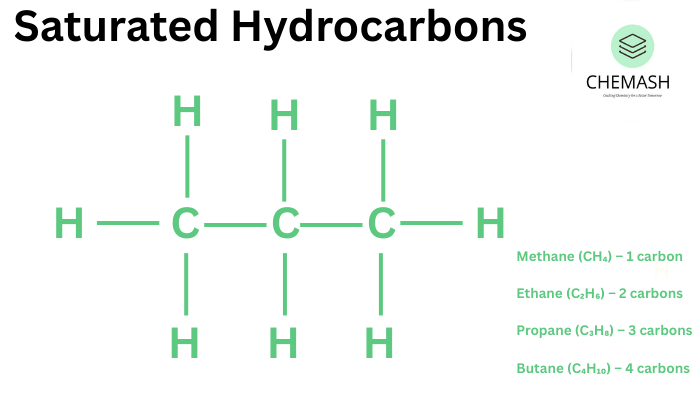
Alkanes are the simplest class of hydrocarbons consisting entirely of single bonds between carbon atoms and saturated with hydrogen atoms. Their general formula is CnH2n+2. They are also called saturated hydrocarbons because they contain the maximum possible number of hydrogen atoms per carbon.
Classification
- Linear alkanes: Carbon atoms connected in a straight chain (n-alkanes).
- Branched alkanes: Chains with alkyl substituents (iso- and neo- structures).
- Cycloalkanes: Ring-shaped saturated hydrocarbons (CnH2n); often discussed with alkanes but are technically cycloalkanes.
Nomenclature
Alkanes are named by selecting the longest carbon chain, numbering it for the lowest set of locants, naming substituents, and using the suffix -ane. Examples:
- Methane (CH₄) – 1 carbon
- Ethane (C₂H₆) – 2 carbons
- Propane (C₃H₈) – 3 carbons
- Butane (C₄H₁₀) – 4 carbons
Physical Properties
- Non-polar molecules: insoluble in water but soluble in organic solvents (e.g., hexane, benzene).
- Boiling and melting points increase with molecular weight (due to increased van der Waals forces).
- Lower alkanes (C1–C4) are gases at room temperature; medium alkanes are liquids; very high alkanes are waxy solids.
Chemical Properties
1. Combustion
Alkanes burn in oxygen to produce carbon dioxide and water, releasing energy. Example (general):
CnH2n+2 + (3n+1)/2 O2 → n CO2 + (n+1) H2O
2. Free Radical Substitution (Halogenation)
Under UV light, halogens react with alkanes by a chain mechanism producing haloalkanes and hydrogen halides. The three main steps are initiation, propagation, and termination.
3. Stability
Alkanes are relatively inert toward many reagents because of strong C–C and C–H bonds and lack of polarity. They are commonly used as solvents and fuels but require energetic conditions for many reactions.
Uses
- Fuels (natural gas — methane, petrol/diesel — mixtures of alkanes).
- Feedstock in the petrochemical industry to make plastics, detergents, solvents and more.
- Lubricants, waxes, and paraffin products.
Summary:
Alkanes are fundamental hydrocarbons with saturated carbon chains. Their chemical inertness and combustion properties make them vital fuels and industrial feedstocks.
Multiple Choice Questions (MCQs)
- General formula of alkanes is: A. CnH2n B. CnH2n+2 C. CnH2n-2 D. CnHn Answer: B. Explanation: Alkanes have the general formula CnH2n+2.
- Which reaction mechanism is involved in halogenation of alkanes? A. Electrophilic addition B. Nucleophilic substitution C. Free radical substitution D. Elimination Answer: C. Explanation: Halogenation of alkanes proceeds via a free radical chain mechanism.
- Which of the following alkanes is a gas at room temperature? A. Nonane B. Octane C. Methane D. Octadecane Answer: C. Explanation: Methane (CH₄) is a gas at room temperature.
Click “Show answers” to reveal explanations. Show answers
Fill in the blanks
- Alkanes are also called __________ hydrocarbons. Answer: saturated
- The IUPAC suffix for alkanes is __________. Answer: -ane
- General molecular formula of alkanes is __________. Answer: CnH2n+2
Show answers
Quick Quiz — Auto grade (3 questions)
- 1. What is the IUPAC name for CH₃–CH₂–CH₂–CH₃? Propane Butane Pentane
- 2. Which statement is TRUE about alkanes? They contain double bonds. They are highly polar. They are relatively inert and nonpolar.
- 3. During complete combustion of propane (C₃H₈), main gaseous products are: CO + H₂ CO₂ + H₂O C + H₂O
Submit Answers
Explanations
- Butane is CH₃–CH₂–CH₂–CH₃ (4 carbons). IUPAC name: butane.
- Alkanes are relatively inert and nonpolar due to strong C–C and C–H bonds.
- Complete combustion produces carbon dioxide (CO₂) and water (H₂O).
Frequently Asked Questions (FAQ)
Q1: What is an alkane?
A: An alkane is a saturated hydrocarbon with only single C–C bonds and general formula CnH2n+2.
Q2: Why are alkanes less reactive?
A: Because C–H and C–C bonds are relatively strong and nonpolar; reactions often need heat, light (UV) or catalysts.
Q3: How are alkanes named when branched?
A: Find the longest chain as parent, number for lowest substituent locants, name alkyl groups and assemble the name using commas and hyphens per IUPAC rules.
References & links
- External: IUPAC — International Union of Pure and Applied Chemistry
Author: CHEMASH
Date: Sep 03, 2025
