
Principles of Green Chemistry
Principles of Green Chemistry explain how to design safer, more sustainable chemical products and processes that minimise waste, energy use, and hazards.
What is Green Chemistry?
Principles of Green Chemistry are a set of guidelines for designing chemical products and processes that reduce or eliminate hazardous substances. Green chemistry focuses on sustainability, safety, and efficiency from research through disposal.
Introduced by Paul Anastas and John Warner in the 1990s, these principles inform industry and academia in pharmaceuticals, polymers, agrochemicals, and materials science.
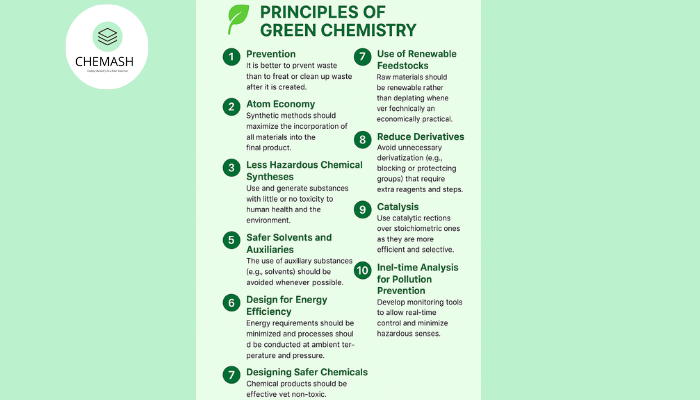
The 12 Principles of Green Chemistry
- Prevention: Better to prevent waste than treat or clean up after it.
- Atom Economy: Design syntheses to maximize incorporation of materials into the final product.
- Less Hazardous Syntheses: Use and produce substances with low toxicity.
- Design Safer Chemicals: Products should be effective yet non-toxic.
- Safer Solvents & Auxiliaries: Avoid or substitute hazardous solvents.
- Energy Efficiency: Minimize energy requirements; favor ambient temperature/pressure.
- Renewable Feedstocks: Prefer renewable materials over depleting ones.
- Reduce Derivatives: Avoid unnecessary blocking/protecting groups.
- Catalysis: Prefer catalytic reagents over stoichiometric ones.
- Design for Degradation: Products should break down into innocuous substances.
- Real-time Analysis: Monitor and control processes to prevent pollution.
- Inherently Safer Chemistry: Choose forms and substances that minimize accident risk.
Applications and Benefits
- Reduced toxic waste from manufacturing and labs.
- Improved worker safety and lower environmental liability.
- Lower energy and resource consumption (savings + sustainability).
- Design of biodegradable consumer products and safer pharmaceuticals.
- Industry examples: greener solvents in pharma, catalytic polymerization, biomass feedstocks for chemicals.
For industry case studies and further reading, see CHEMASH pages on green solvents and renewable feedstocks.
Quiz – Principles of Green Chemistry
- Which of the following is the first principle of green chemistry?
a) Use of renewable feedstocks b) Atom economy c) Prevention d) Catalysis
Answer: c) Prevention — It’s better to prevent waste than to treat it later. - Which principle focuses on maximizing material use in the final product?
a) Design for degradation b) Real-time analysis c) Atom economy d) Energy efficiency
Answer: c) Atom economy — It increases resource efficiency and reduces by-products. - Which principle encourages using catalysts?
a) Derivatization b) Real-time analysis c) Catalysis d) Design for degradation
Answer: c) Catalysis — Catalysts improve selectivity and reduce reagent use. - Green chemistry aims to use which feedstocks?
a) Expensive b) Renewable c) Petroleum-based d) Inert
Answer: b) Renewable — Prefer biomass or other renewable raw materials where practical.
FAQs
Is green chemistry the same as environmental chemistry?
Not exactly. Environmental chemistry studies chemical processes in the environment; green chemistry focuses on designing safer processes and products to prevent pollution at the source.
How can small labs apply green chemistry?
Start by substituting safer solvents, minimizing reagent excess, using catalysts, designing degradable products, and monitoring reactions to reduce waste.
Up Next: Sustainable Chemistry in Industry
© 2025 CHEMASH — Learn. Apply. Sustain.

Pingback: Sustainable Chemical Processes - CHEMASH