
Reagents in Organic Chemistry
Introduction
In organic chemistry, reagents are substances or compounds that drive chemical reactions. They help in breaking or forming bonds during organic transformations and are essential in synthesis pathways.
Related: Introduction to Organic Chemistry
Types of Reagents in Organic Chemistry
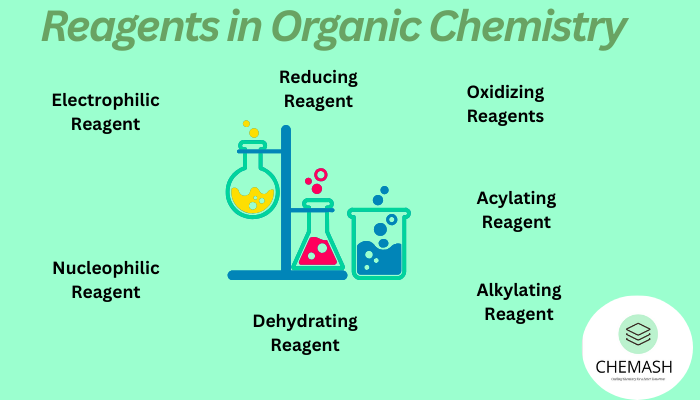
1. Electrophilic Reagents
- Definition: Electron-deficient species that accept electron pairs.
- Examples: H⁺, Br₂, NO₂⁺, AlCl₃
- Common Reactions: Electrophilic addition, Electrophilic substitution
2. Nucleophilic Reagents
- Definition: Electron-rich species that donate electron pairs.
- Examples: OH⁻, NH₃, CN⁻, RO⁻
- Common Reactions: SN1, SN2, Nucleophilic addition
3. Reducing Agents
- Function: Add hydrogen / remove oxygen (decrease oxidation state).
- Examples: LiAlH₄, NaBH₄, H₂/Pd, Zn/HCl
- Uses: Reduction of aldehydes, ketones, carboxylic acids → alcohols
4. Oxidizing Agents
- Function: Add oxygen / remove hydrogen (increase oxidation state).
- Examples: KMnO₄, CrO₃, PCC, H₂O₂
- Uses: Oxidation of alcohols → aldehydes, ketones, acids
5. Acylating Agents
- Definition: Introduce acyl groups (RCO–).
- Examples: Acetyl chloride (CH₃COCl), Acetic anhydride
- Uses: Friedel–Crafts acylation, ester formation
6. Alkylating Agents
- Definition: Introduce alkyl groups (R–).
- Examples: CH₃I, (CH₃)₂SO₄
- Uses: Alkylation of amines, phenols, carboxylates
7. Dehydrating Reagents
- Definition: Remove water / promote elimination.
- Examples: P₂O₅, H₂SO₄, Al₂O₃
- Uses: Dehydration of alcohols → alkenes
Key Points to Remember
- The choice of reagent decides the reaction pathway & final product.
- Temperature, solvent, and catalysts strongly influence outcomes.
- Some reagents are selective and only react with certain functional groups.
Quiz: Test Your Knowledge
1. Which of the following is a reducing agent?
✅ LiAlH₄
2. Which reagent oxidizes primary alcohol → aldehyde?
✅ PCC
3. Which is a nucleophile?
✅ OH⁻
4. Reagent for acylation of aromatic compounds?
✅ CH₃COCl
5. Which is a typical dehydrating reagent?
✅ P₂O₅
Related Reading: Reaction Mechanisms in Organic Chemistry
Bilingual Section (English + Hindi)
English:
Electrophiles are electron-deficient species that attack nucleophilic centers.
हिंदी (Hindi):
इलेक्ट्रोफाइल वे प्रजातियाँ हैं जिनमें इलेक्ट्रॉनों की कमी होती है और जो न्यूक्लियोफिलिक केंद्रों पर आक्रमण करती हैं।
Frequently Asked Questions (FAQ)
Q1: What is the difference between a reagent and a reactant?
A reagent is added to cause a reaction, while a reactant is consumed to form products.
Q2: Which is stronger – LiAlH₄ or NaBH₄?
LiAlH₄ is stronger and can reduce esters and acids, while NaBH₄ is milder.
Q3: Why is PCC preferred for aldehyde synthesis?
Because it stops oxidation at the aldehyde stage without over-oxidizing to acids.
Conclusion
Reagents are the tools of organic synthesis, enabling transformations such as reduction, oxidation, substitution, and addition. Mastering their functions is crucial for excelling in organic chemistry.
