
Rubber (natural or synthetic) is an elastic polymer widely used in industry and everyday products. The discovery of vulcanization transformed rubber by creating durable, elastic materials suitable for tires, seals, gloves and more.
1. Natural Rubber — Isoprene Polymer & Latex Source
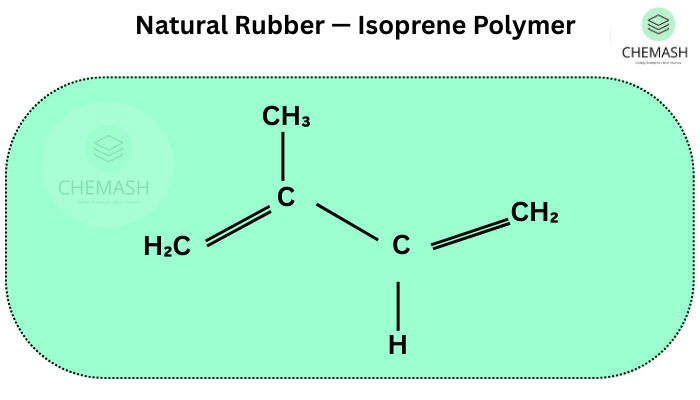
Origin, structure and basic properties (isoprene, Hevea brasiliensis)
Natural rubber is poly(isoprene) extracted from the latex of Hevea brasiliensis. In raw form it is soft and tacky, with limited heat and ozone resistance.
2. Synthetic Rubber — Types, Properties & Typical Uses
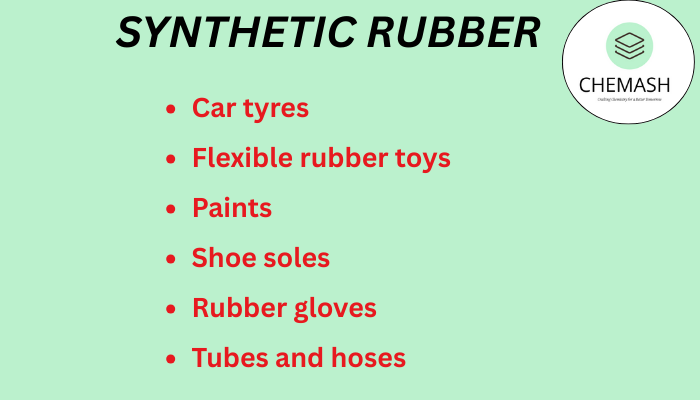
Common synthetic elastomers (SBR, Neoprene, Buna-N) and industry applications
Synthetic rubbers are produced to target specific properties:
- Styrene-Butadiene Rubber (SBR) — major tyre ingredient.
- Neoprene — oil and chemical resistance for seals and wetsuits.
- Buna-N (Nitrile) — fuel/oil resistant hoses and gaskets.
3. Vulcanization Process — Chemistry, Conditions & Accelerators
Sulfur cross-linking, peroxide cures and the role of accelerators
Vulcanization forms cross-links (C–S–C or polysulfidic bridges) between polymer chains. Typical sulfur cures use 1–3% sulfur at 140–160°C; accelerators adjust cure speed and crosslink structure. Peroxide curing is used for non-diene rubbers.
4. Effects of Vulcanization — Mechanical, Thermal & Chemical Benefits
- Increased elasticity, resilience and tensile strength
- Improved abrasion resistance and reduced tack
- Better thermal, ozone and chemical resistance
5. Applications of Vulcanized Rubber — Automotive, Medical & Industrial Uses
Primary applications include:
- Automobile tires, inner tubes and treads
- Seals, gaskets, hoses, conveyor belts
- Footwear, industrial flooring, sporting goods
- Medical gloves and elastic bands
Internal (CHEMASH):
Quiz: Rubber & Vulcanization (MCQs)
- Q1. Main monomer of natural rubber?
A) Ethylene B) Propylene C) Isoprene D) Butadiene
Answer: C — Isoprene (2-methyl-1,3-butadiene). - Q2. Purpose of vulcanization?
A) Melt rubber B) Color rubber C) Improve strength & elasticity D) Make rubber water soluble
Answer: C — Increases mechanical strength and stability. - Q3. Who discovered vulcanization?
A) John Dalton B) Charles Goodyear C) Alfred Nobel D) Leo Baekeland
Answer: B — Charles Goodyear (1839). - Q4. Which is a synthetic rubber?
A) Chitosan B) Nylon-6 C) Neoprene D) Polyethylene
Answer: C — Neoprene is synthetic and oil-resistant.
Frequently Asked Questions
What is vulcanization?
Vulcanization is the chemical process of creating cross-links between polymer chains (commonly using sulfur), converting sticky raw rubber into a resilient, elastic material.
Are all rubbers vulcanized with sulfur?
No. Diene rubbers typically use sulfur cures; non-diene rubbers (silicones, EPDM) often use peroxides or specialty curatives.
How much sulfur is used in typical vulcanization?
Common formulations use about 1–3% elemental sulfur, but exact amounts depend on rubber type and desired properties.
Published by CHEMASH • Last updated: 11 Sep 2025
