
Standard Types of Flip-Flops
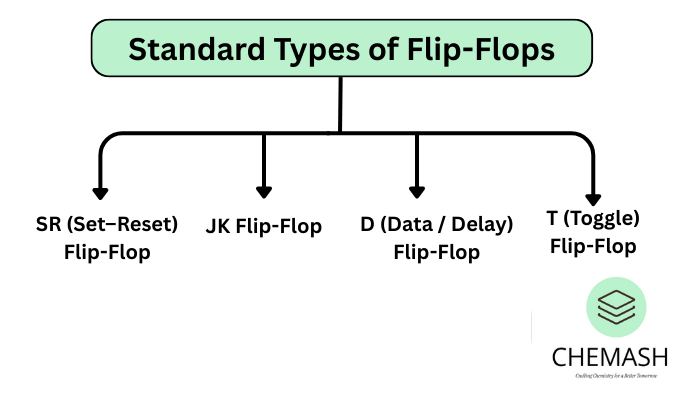
Flip-flops are fundamental building blocks of sequential digital circuits. They store binary information and change their state only on a clock edge. The most commonly used flip-flops are SR, D, JK, and T flip-flops.
1. SR Flip-Flop (Set–Reset)
The SR flip-flop is the most basic memory element. It has two inputs: S (Set) and R (Reset).
- S = 1 sets the output Q to 1
- R = 1 resets the output Q to 0
SR Flip-Flop Truth Table
| S | R | Q(n+1) | Description |
|---|---|---|---|
| 0 | 0 | Q(n) | No change |
| 0 | 1 | 0 | Reset |
| 1 | 0 | 1 | Set |
| 1 | 1 | Invalid | Forbidden state |
Invalid State Problem
When S = 1 and R = 1, both outputs Q and Q′ become 0, violating the complementary rule. This makes the output unpredictable. Due to this invalid state, the SR flip-flop is rarely used in practical designs.
2. D Flip-Flop (Data / Delay)
The D flip-flop eliminates the invalid state of the SR flip-flop. It has only one input: D (Data).
On every active clock edge, the output Q takes the value present at D.
D Flip-Flop Truth Table
| D | Q(n+1) |
|---|---|
| 0 | 0 |
| 1 | 1 |
Characteristic Equation
Q(n+1) = D
Applications
- Registers
- Data storage
- Synchronization circuits
3. JK Flip-Flop
The JK flip-flop is an improved version of the SR flip-flop. It removes the invalid state by introducing a toggle mode.
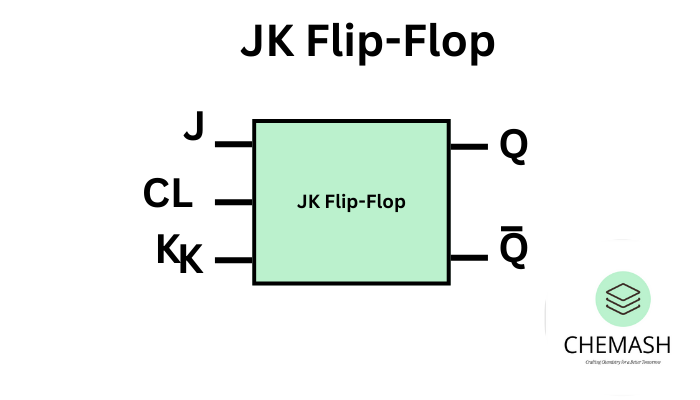
JK Flip-Flop Truth Table
| J | K | Q(n+1) | Operation |
|---|---|---|---|
| 0 | 0 | Q(n) | No change |
| 0 | 1 | 0 | Reset |
| 1 | 0 | 1 | Set |
| 1 | 1 | Q′(n) | Toggle |
Characteristic Equation
Q(n+1) = JQ' + K'Q
Advantages
- No invalid state
- Highly versatile
- Used in counters
4. T Flip-Flop (Toggle)
The T flip-flop is a simplified form of the JK flip-flop with J = K = T.
T Flip-Flop Truth Table
| T | Q(n+1) | Operation |
|---|---|---|
| 0 | Q(n) | No change |
| 1 | Q′(n) | Toggle |
Characteristic Equation
Q(n+1) = T ⊕ Q(n)
Applications
- Binary counters
- Frequency division
Conclusion
Each flip-flop has unique characteristics and applications. SR flip-flops introduce the concept of memory, D flip-flops are ideal for data storage, JK flip-flops offer versatility, and T flip-flops are best suited for counting operations.Standard Types of Flip-Flops
Flip-flops are fundamental building blocks of sequential digital circuits . Understanding the standard types of flip-flops is essential for designing any memory-based system. These devices store binary information and change their state only on a clock edge. The most commonly used standard types of flip-flops are SR, D, JK, and T flip-flops.
