
A concise guide to ionization strength, pH behaviour, real-world uses and practice questions. Strength of Acids and Bases
Strength refers to how completely an acid or base ionizes in water to produce H⁺ or OH⁻ ions. Complete ionization indicates a strong acid/base, while partial ionization indicates a weak one. Understanding ionization helps predict pH and reactivity in real systems. Strength of Acids and Bases
1. Strong vs. Weak Acids
- Strong acids: Ionize almost completely in aqueous solution — typical examples: HCl, HNO3, H2SO4.
- Weak acids: Only a fraction of molecules donate H+ (partial ionization) — e.g., CH3COOH, H2CO3, HF.
2. Strong vs. Weak Bases
- Strong bases: Fully dissociate to release OH− (NaOH, KOH, Ca(OH)2).
- Weak bases: Associate/partially accept protons in water (NH3, Mg(OH)2).
3. Key Factors that Influence Strength
- Bond strength: When the H–X bond is weaker, the acid more readily releases H+.
- Electronegativity: More electronegative atoms pull electron density away from H, stabilizing ionization.
- Resonance stabilization: Conjugate bases that delocalize negative charge make their acids stronger.
- Solvent effects: Ionization depends strongly on the solvent’s polarity and hydrogen-bonding ability.
4. pH Scale (0–14) and Typical Values
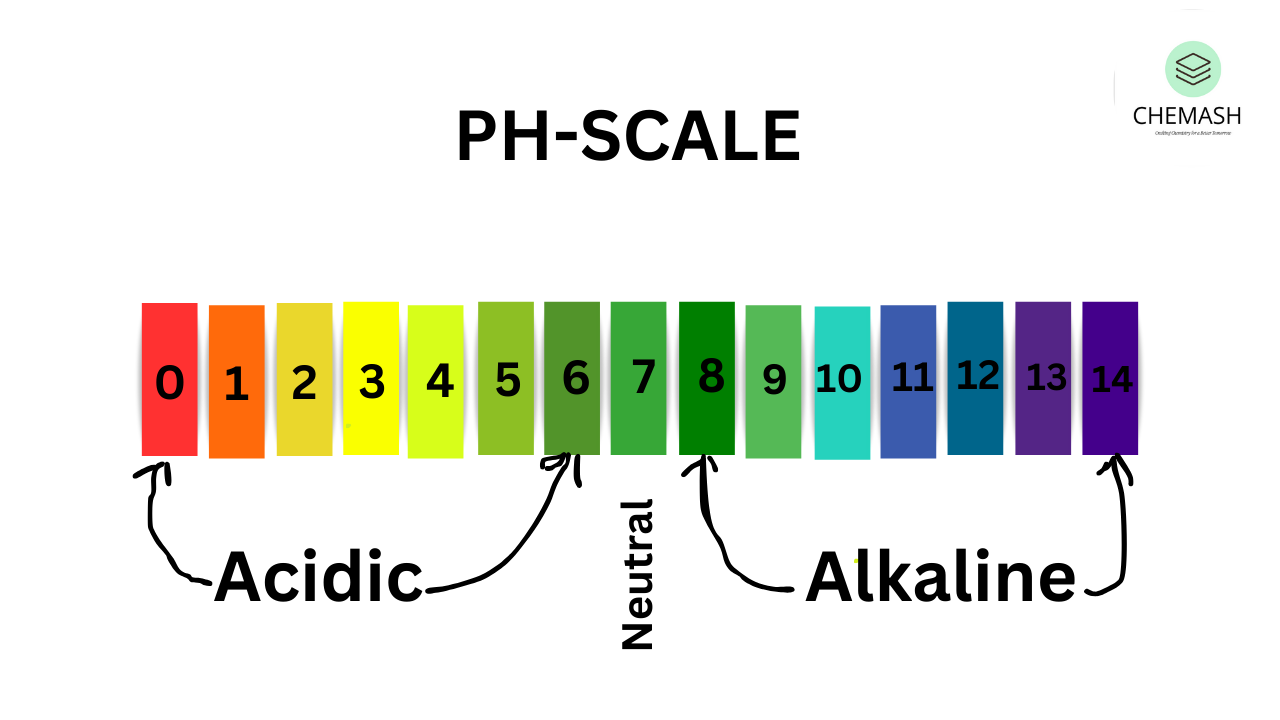
pH is a logarithmic measure of hydrogen ion concentration. Very strong acids may show pH close to 0, while strong bases approach pH 14. Most weak acids/bases lie nearer to neutral (pH ≈ 7) depending on concentration.
| Acid/Base | Strong/Weak | Dissociation | Example pH (approx.) |
|---|---|---|---|
| HCl (Hydrochloric acid) | Strong acid | Complete | ≈ 0–1 |
| CH3COOH (Acetic acid) | Weak acid | Partial | ≈ 4–5 |
| NaOH (Sodium hydroxide) | Strong base | Complete | ≈ 13–14 |
| NH3 (Ammonia) | Weak base | Partial | ≈ 9–10 |
5. Real-World Applications
- Medicine: Antacids (weak bases) neutralize excess stomach acid.
- Industry: Strong acids and bases are used in synthesis, cleaning, and battery electrolytes.
- Agriculture: Soil pH adjustment uses acidic or basic amendments to optimize nutrient availability.
- Household: Drain cleaners often contain strong bases (e.g., NaOH) for their reactivity with organic clogs.
6. Summary
Strength depends on the extent of ionization in the solvent. Full dissociation defines strong acids/bases; partial dissociation defines weak ones. Apply the factors above to anticipate behaviour in reactions and solutions.
Quiz: Strength of Acids and Bases
Q1: Which of the following is a strong base?
A) NH3 B) NaOH C) CH3COOH D) H2CO3
Answer: B) NaOHNaOH dissociates completely in water, releasing OH⁻ ions.
Q2: Which acid is weak among the following?
A) HCl B) HNO3 C) H2SO4 D) CH3COOH
Answer: D) CH3COOHAcetic acid ionizes only partially in water.
Q3: The strength of an acid is most directly related to:
A) Molar mass B) Temperature C) Extent of dissociation D) Boiling point
Answer: C) Extent of dissociationExtent of ionization determines whether an acid is strong or weak.
Q4: pH of a strong acid is typically:
A) Around 7 B) 5–6 C) < 3 D) > 10
Answer: C) < 3Strong acids produce high [H+] giving very low pH values.
Q5: Which of the following is NOT a direct factor affecting acid strength?
A) Bond strength B) Electronegativity C) Solvent D) Atomic number
Answer: D) Atomic numberAtomic number is not used directly; related properties might influence strength but it’s not a direct factor.
Author: CHEMASH • Last reviewed: September 12, 2025
