
Sustainable Chemistry (Green Chemistry)
Sustainable chemistry, also known as green chemistry, focuses on designing chemical products and processes that reduce or completely eliminate the use and generation of hazardous substances. Moreover, it aims to protect human health while conserving natural resources. Therefore, it is plays a crucial role in achieving long-term environmental balance.
Table of Contents
- What is Sustainable Chemistry?
- Need for Sustainable Chemistry
- Principles of Green Chemistry
- Applications
- Real-Life Examples
- Benefits and Importance
- Summary
- Quiz & Practice
- Frequently Asked Questions
What is Sustainable Chemistry?
it is refers to the development of chemical processes that minimize environmental pollution. Instead of controlling pollution after it forms, this approach prevents waste generation at the source. As a result, industries become cleaner, safer, and more energy-efficient.
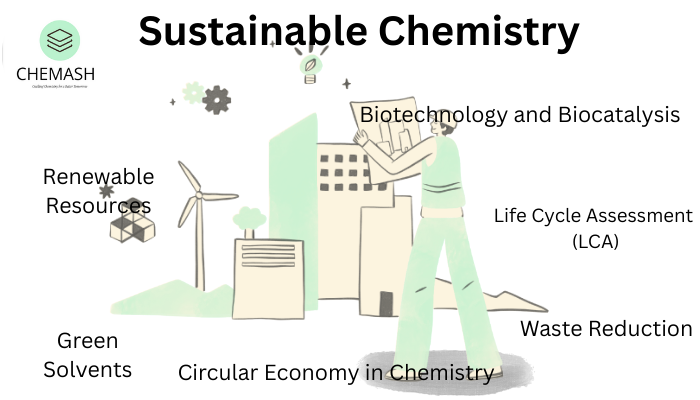
From an academic perspective, sustainable chemistry is closely linked to Industrial Chemistry, Environmental Chemistry
Why Sustainable Chemistry Is Needed
Traditional chemical industries often generate toxic waste and consume non-renewable resources. Consequently, these practices contribute to pollution, climate change, and health hazards. Therefore, sustainable provides an alternative path that balances industrial growth with environmental protection.
Principles of Green Chemistry
Paul Anastas and John Warner proposed twelve principles of green chemistry. Together, these principles guide chemists toward sustainable practices. Some key principles include:
- Prevention of waste rather than treatment
- Maximum atom economy
- Use of safer solvents and reaction conditions
- Designing energy-efficient processes
- Use of renewable raw materials
- Designing biodegradable products
Applications
it is finds wide applications across multiple industries. For instance, pharmaceutical companies now design greener drug synthesis routes. Similarly, polymer industries develop biodegradable plastics to reduce plastic pollution.
- Green pharmaceuticals
- Bio-based fuels
- Eco-friendly polymers
- Renewable energy materials
- Water purification technologies
Real-Life Examples
Several real-world applications demonstrate the success of sustainable . For example, replacing chlorinated solvents with water-based solvents has significantly reduced environmental toxicity. Additionally, catalytic reactions now replace stoichiometric reactions, thereby minimizing waste generation.
Benefits and Importance
Sustainable benefits both industry and society. On one hand, it reduces production costs through energy efficiency. On the other hand, it protects ecosystems and human health. Hence, it supports sustainable development goals.
- Reduced environmental pollution
- Improved industrial safety
- Efficient use of resources
- Lower carbon footprint
- Long-term economic sustainability
Summary
In conclusion, sustainable chemistry represents the future of chemical science. By emphasizing prevention, efficiency, and safety, it ensures that chemical advancements do not harm the planet. Therefore, adopting sustainable remains essential for a healthier and more sustainable world.
Quiz & Practice
1. Sustainable chemistry is also known as:
Green Chemistry
2. Which principle focuses on waste prevention?
Prevention principle
Frequently Asked Questions
Is it part of green chemistry?
Yes, it is a broader concept that strongly overlaps with green chemistry.
Why is sustainable important for industries?
It reduces waste, lowers costs, and ensures environmental compliance.
US EPA – Green Chemistry | Britannica | UNEP
it is not a choice — it is a responsibility.
