
Types of Chemical Bonds
By CHEMASH • September 18, 2025
Chemical bonds are the forces that hold atoms together in molecules or compounds. This guide explains the major bond types — ionic, covalent, metallic, coordinate (dative), hydrogen bonding, and Van der Waals forces — with clear examples, properties, a summary table, MCQs with step-by-step explanations, and FAQs.
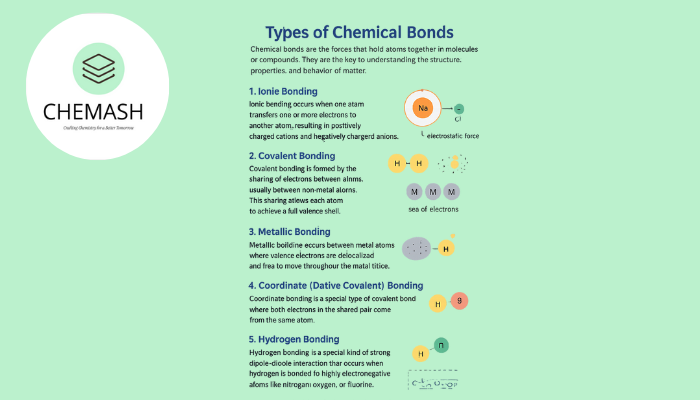
1. Ionic Bonding
Ionic bonding occurs when one atom transfers one or more electrons to another atom. The resulting positively charged cation and negatively charged anion attract by electrostatic forces to form an ionic lattice.
- Formation: Common between metals (electron donors) and nonmetals (electron acceptors).
- Example: Sodium chloride (NaCl), where Na → Na+ and Cl ← Cl–.
- Properties: High melting/boiling points, crystalline solids, conduct electricity when molten or dissolved (ions mobile), brittle.
2. Covalent Bonding
Covalent bonding is formed by the sharing of electron pairs between atoms. Usually occurs between nonmetals; sharing allows each atom to approach noble-gas electron configuration.
- Types: Single (1 pair, e.g., H–H), double (2 pairs, e.g., O=O), triple (3 pairs, e.g., N≡N).
- Example: Water (H2O) and methane (CH4).
- Properties: Lower melting/boiling points than ionic solids (often gases/liquids), poor electrical conductivity, directional bonds (specific angles/geomtries).
3. Metallic Bonding
In metals, valence electrons are delocalised over a lattice of positive ions — a “sea of electrons.” This gives metals high thermal/electrical conductivity and mechanical properties like malleability and ductility.
- Example: Copper (Cu), iron (Fe), aluminium (Al).
- Properties: Conduct electricity & heat, malleable, ductile, lustrous.
4. Coordinate (Dative Covalent) Bonding
Coordinate bonds are covalent bonds where both electrons in the shared pair originate from the same atom (a Lewis base) which donates to an electron-poor acceptor (a Lewis acid).
- Example: Ammonium ion (NH4+) formed when NH3 donates a lone pair to H+.
- Note: The resulting bond behaves like a covalent bond, but sometimes shown with an arrow (→) indicating direction of donation.
5. Hydrogen Bonding
Hydrogen bonding is a special, relatively strong dipole–dipole attraction: a hydrogen covalently bonded to a highly electronegative atom (N, O, F) interacts with a lone pair on another electronegative atom.
- Examples: Water (H2O), ammonia (NH3), hydrogen fluoride (HF).
- Importance: Explains the high boiling point of water, specific heat, and biological structures (DNA base pairing, protein folding).
6. Van der Waals Forces (Dispersion & Dipole-Dipole)
Van der Waals forces are weaker intermolecular forces that influence the physical properties of molecular substances:
- London dispersion: Present in all molecules due to instantaneous induced dipoles; grows with molecular size and polarizability.
- Dipole–dipole: Between permanent polar molecules (e.g., HCl).
- Examples: Noble gases (Ar), O2, nonpolar molecules; important for boiling point trends across homologous series.
Summary Table of Chemical Bonds
| Type of Bond | Description | Example | Properties |
|---|---|---|---|
| Ionic | Transfer of electrons; electrostatic attraction | NaCl | High m.p./b.p.; conducts when molten/aqueous; brittle |
| Covalent | Sharing of electron pairs | H2O, CH4 | Variable states; poor electrical conductor; directional |
| Metallic | Delocalised electrons among metal cations | Cu, Fe | Conductive; malleable; lustrous |
| Coordinate (Dative) | Both bonding electrons donated by one atom | NH4+ | Directional; chemically similar to covalent |
| Hydrogen Bond | Strong dipole attraction where H is bonded to N/O/F | H2O, NH3 | Elevated b.p., important in biology |
| Van der Waals | Weak intermolecular attractions (dispersion/dipole) | Ar, O2, HCl | Influences boiling/melting points; weaker forces |
Further reading: Encyclopaedia Britannica — Chemical bond. Official standards and naming: IUPAC.
Related CHEMASH pages: Electronic configuration • Ionic bonding (detailed)
MCQ Quiz — Test your understanding
Use the MCQs to self-check. Answers and explanations are revealed using the native <details> element (works without JavaScript).
Q1: Which of the following best describes a coordinate (dative) covalent bond?
- A bond where electrons are transferred completely from one atom to another
- A bond where both bonding electrons are donated by the same atom
- A bond with delocalised electrons across a lattice
- A weak intermolecular attraction
Answer & Explanation
Correct: 2. A coordinate bond occurs when one atom supplies both electrons for the shared pair (e.g., NH3 → H+ to form NH4+).
Q2: Which statement is true about metals?
- They have localized valence electrons that do not move.
- They cannot conduct electricity in any state.
- They have delocalized electrons enabling conductivity and malleability.
- They form ionic bonds exclusively.
Answer & Explanation
Correct: 3. Metallic bonds involve delocalized electrons that allow electrical conductivity and plastic deformation (malleability).
Q3: Hydrogen bonding is strongest when hydrogen is bonded to which atom?
- Carbon
- Oxygen
- Silicon
- Sulfur
Answer & Explanation
Correct: 2. Oxygen (and N, F) are highly electronegative and form strong hydrogen bonds when H is attached to them (e.g., H–O in water).
Q4: Which force is mainly responsible for the condensation of nonpolar gases at low temperatures?
- Hydrogen bonding
- London dispersion forces
- Metallic bonding
- Covalent bonding
Answer & Explanation
Correct: 2. London dispersion forces (instantaneous induced dipoles) cause attraction between nonpolar atoms/molecules and lead to liquefaction at low temperatures.
Q5: Which of these properties is typical of ionic compounds?
- Low melting points
- Good electrical conductivity as solids
- Brittle crystalline solids with high melting points
- Delocalised electrons enabling ductility
Answer & Explanation
Correct: 3. Ionic solids are usually brittle, crystalline, and have high melting points because of strong electrostatic attractions in the lattice. They conduct only when molten or dissolved.
Tip: For practice, try explaining each bond type out loud and draw the electron movement or sharing — teaching is one of the best ways to learn chemistry.
Frequently Asked Questions (FAQs)
Q: How does electronegativity affect bond type?
A: Large electronegativity difference between atoms (often >~1.7 depending on scale) favours ionic character; small differences favour covalent bonding. Electronegativity also influences bond polarity and hydrogen bonding capability.
Q: Can a bond be partly ionic and partly covalent?
A: Yes. Most bonds lie on a spectrum between purely ionic and purely covalent. Many so-called “ionic” compounds have some covalent character and vice versa. The polar covalent bond is an intermediate case.
Q: Are hydrogen bonds considered chemical bonds?
A: Hydrogen bonds are not covalent bonds between atoms; they are intermolecular (or intramolecular) forces that are stronger than typical Van der Waals interactions but weaker than covalent bonds. They play crucial roles in molecular structure and properties.
