
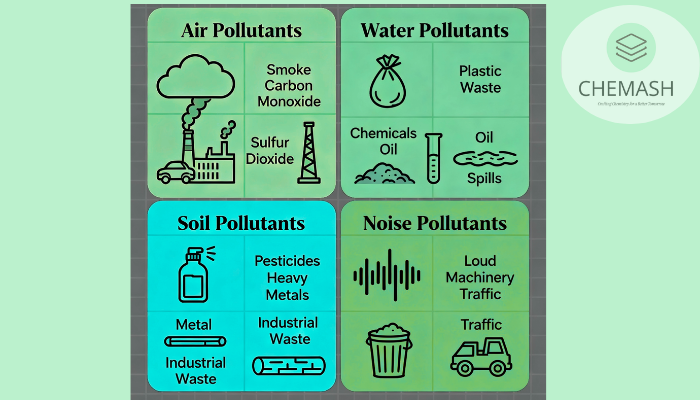
Types of Pollutant
Types of pollutant affect air, water, soil, and living organisms. Understanding these types—by origin, state, and effects—helps policymakers, scientists, and the public reduce harm and protect health and ecosystems
Table of Contents
Introduction
Types of pollutant affect air, water, soil, and living organisms. Understanding these types—by origin, state, and effects—helps policymakers, scientists, and the public reduce harm and protect health and ecosystems. Below we classify pollutants clearly and provide examples, quiz questions, and helpful links.
Based on Origin
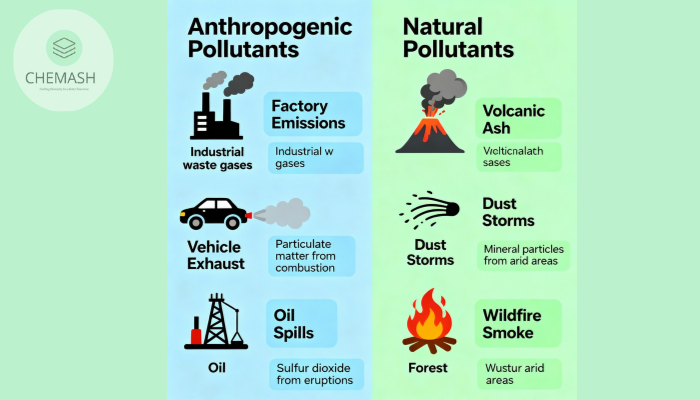
Natural pollutants: These arise from natural events such as volcanic eruptions, wildfires, dust storms, and pollen. Although natural, they can cause significant environmental and health impacts when intense.
Anthropogenic (man-made) pollutants: These originate from human activities such as industrial emissions, vehicle exhaust, agricultural chemicals, and improper waste disposal. They form the bulk of persistent pollution challenges today.
Based on Physical State
Gaseous pollutants: Include carbon monoxide (CO), sulfur dioxide (SO₂), nitrogen oxides (NOₓ), ozone (O₃), and volatile organic compounds (VOCs). These often affect air quality and human respiratory health.
Particulate pollutants: Solid or liquid particles suspended in air, such as dust, soot, smoke, and aerosols. Fine particulates (PM2.5) penetrate deep into lungs and bloodstream.
Liquid pollutants: Contaminants in water bodies, including oils, pesticides, industrial effluents, and chemical spills that harm aquatic life and water quality.
Based on Effects
Primary pollutants: Emitted directly from sources. For example, carbon monoxide from vehicles and sulfur dioxide from power plants.
Secondary pollutants: Formed in the atmosphere via chemical reactions. Examples include ground-level ozone and components of smog.
Biodegradable pollutants: Organic wastes that microbes can break down, such as food waste and some sewage components.
Non-biodegradable pollutants: Materials that resist natural breakdown and persist for long periods, such as heavy metals (lead, mercury) and many plastics.
Quiz
Answers and short explanations are below. Use the <details> blocks to reveal each answer for a clean page and indexing.
- Which of the following is a primary pollutant?
a) Ozone (O₃)
b) Carbon monoxide (CO)
c) Smog
d) Acid rain Answer: b) Carbon monoxide (CO) Explanation: Carbon monoxide emits directly from vehicles and combustion sources; it is a primary pollutant. - Particulate pollutants are:
a) Only gases
b) Suspended solid or liquid particles in air
c) Only liquids
d) Always biodegradable Answer: b) Suspended solid or liquid particles in air Explanation: Particulates include dust, soot, and aerosols; fine particles (PM2.5) pose major health risks. - Non-biodegradable pollutants include:
a) Organic waste
b) Heavy metals and plastics
c) Pollen
d) Carbon dioxide Answer: b) Heavy metals and plastics Explanation: Heavy metals and many plastics do not break down easily and persist in ecosystems. - Anthropogenic pollutants are:
a) Natural pollutants
b) Man-made pollutants
c) Only particulate matter
d) Only gaseous pollutants Answer: b) Man-made pollutants Explanation: These originate from human activities like industry, transport, and agriculture.
Frequently Asked Questions
What causes secondary pollutants?
Secondary pollutants arise when primary pollutants react chemically in the atmosphere. For example, NOx and VOCs react under sunlight to form ground-level ozone (a component of smog).Are all particulates harmful?
Not all particulates cause severe harm, but fine particles (PM2.5) can penetrate deep into lungs and the bloodstream and are linked to cardiovascular and respiratory diseases.How can we reduce non-biodegradable pollution?
Reduce single-use plastics, improve waste management and recycling, regulate industrial discharges, and phase out harmful persistent chemicals through policy and innovation.
Effects of Air Pollution
Published by CHEMASH — Updated: October 12, 2025
