
Vitamins – Essential Micronutrients | Classification of Vitamins
Vitamins are essential micronutrients that the human body needs in very small quantities. However, despite their tiny requirement, they play a crucial role in maintaining life. Moreover, vitamins actively regulate metabolism, immunity, growth, and tissue repair. Since the body cannot synthesize most vitamins, we must obtain them regularly through diet.
Table of Contents
- What Are Vitamins?
- Classification of Vitamins
- Functions of Key Vitamins
- Vitamin Deficiency Diseases
- Natural Sources of Vitamins
- Summary
- Quiz & Practice
- Frequently Asked Questions
What Are Vitamins? (Essential Micronutrients)
Vitamins are organic compounds that actively participate in biochemical reactions. In most cases, they function as coenzymes or regulatory molecules. As a result, they support normal metabolism, immunity, and cellular growth. Although vitamins do not supply energy directly, they enable energy-producing reactions.
From a chemistry perspective, this topic belongs to Biomolecules under Organic Chemistry.
Classification of Vitamins Based on Solubility
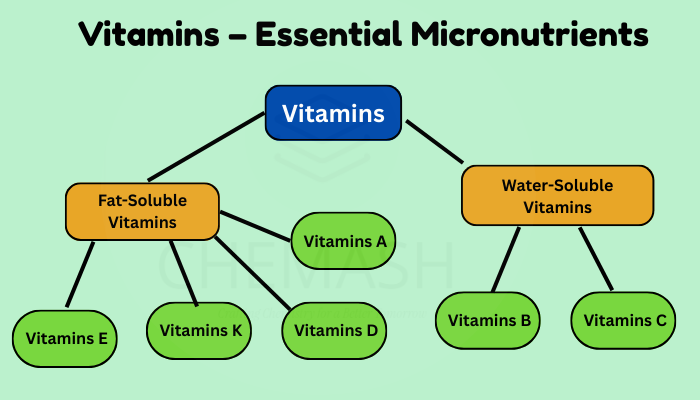
Chemists classify vitamins primarily on the basis of solubility. This classification directly influences absorption, storage, and excretion. Therefore, understanding this division becomes extremely important for health science.
- Fat-soluble vitamins (A, D, E, K): These vitamins dissolve in fats and accumulate in the liver and adipose tissues. Consequently, excessive intake may lead to toxicity.
- Water-soluble vitamins (B-complex and C): These vitamins dissolve in water and circulate freely in blood. Hence, the body excretes excess amounts through urine.
Functions of Vitamins in the Human Body
Each vitamin performs specific biological functions. Together, they maintain overall physiological balance.
- Vitamin A: Supports vision, skin health, and immune defense
- Vitamin D: Enhances calcium absorption and strengthens bones
- Vitamin E: Acts as an antioxidant and protects cell membranes
- Vitamin K: Regulates blood clotting mechanisms
- B-Complex Vitamins: Drive energy metabolism and nervous function
- Vitamin C: Boosts immunity, wound healing, and antioxidant defense
Vitamin Deficiency Diseases
When dietary intake becomes insufficient, deficiency diseases appear. Therefore, early identification remains essential.
- Vitamin A deficiency causes night blindness
- Vitamin D deficiency leads to rickets and osteomalacia
- Vitamin C deficiency results in scurvy
- Vitamin B1 deficiency causes beriberi
- Vitamin B12 deficiency leads to anemia and nerve damage
Natural Dietary Sources of Vitamins
Fortunately, natural foods provide abundant vitamins. Thus, a balanced diet prevents most deficiencies.
- Citrus fruits supply Vitamin C
- Carrots and spinach provide Vitamin A
- Fish and egg yolk supply Vitamin D
- Green leafy vegetables provide Vitamin K
- Milk, meat, nuts, and grains supply B-complex vitamins
Summary: Importance of Vitamins
In conclusion, vitamins are essential micronutrients required for healthy body functioning. Although the body needs them in minute quantities, they exert profound biological effects. Therefore, maintaining adequate vitamin intake through diet remains vital for long-term health.
Quiz & Practice on Vitamins
1. Which vitamin deficiency causes night blindness?
Vitamin A
2. Which of the following is a fat-soluble vitamin?
Vitamin K
Frequently Asked Questions on Vitamins
Why are vitamins called essential micronutrients?
They regulate metabolism, immunity, and growth even though the body needs them in small amounts.
Can the body store all vitamins?
The body stores fat-soluble vitamins, whereas it excretes water-soluble vitamins.
Tiny but mighty — vitamins remain the unsung heroes of human health.
Authoritative references:
Britannica | NCBI
