
Waste Minimization & Energy Efficiency
Waste minimization refers to techniques and practices that reduce the amount and toxicity of waste generated during chemical processes. It is a proactive approach focusing on source reduction rather than treatment or disposal of waste after it is formed.
Essential strategies in sustainable chemistry to reduce environmental impact, operational costs, and resource consumption.
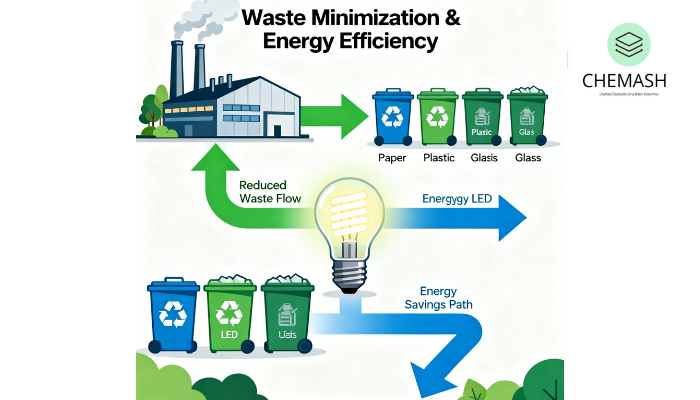
Table of Contents
- What is Waste Minimization?
- Key Strategies
- What is Energy Efficiency?
- Methods to Improve Energy Efficiency
- Quiz (MCQs) with Explanations
- FAQ
- Resources & Links
What is Waste Minimization?
Waste minimization refers to techniques and practices that reduce the amount and toxicity of waste generated during chemical processes. It is a proactive approach focusing on source reduction rather than treatment or disposal of waste after it is formed.
Waste includes not only solid and hazardous materials but also gaseous emissions and wastewater. The aim is to design cleaner, more efficient chemical pathways that eliminate unnecessary byproducts and environmental burdens.
Key Strategies for Waste Minimization
- Process redesign to avoid unwanted side reactions
- Substitution of hazardous chemicals with safer alternatives
- Closed-loop systems for material recovery
- Maximizing atom economy
- Using catalytic over stoichiometric reagents
What is Energy Efficiency?
Energy efficiency in chemical processes refers to the ability to produce desired outputs using the least amount of energy possible. This reduces the carbon footprint, operating costs, and reliance on fossil fuels.
Methods to Improve Energy Efficiency
- Operating at ambient temperature and pressure
- Implementing flow chemistry or microwave-assisted synthesis
- Recovering and recycling heat energy
- Using renewable energy sources like solar and wind
- Utilizing exothermic reactions to fuel other steps
Energy-efficient technologies and equipment also play a crucial role in industrial sustainability.
Quiz – Waste Minimization & Energy Efficiency
Test your knowledge. Answers and explanations are provided below each question. (No JavaScript required — uses <details> for reveal.)
- Which of the following is an example of waste minimization?
a) Burning waste in incinerators
b) Designing a reaction with high atom economy
c) Storing hazardous waste securely
d) Dumping waste in a controlled landfill n Answer: b) Designing a reaction with high atom economy Explanation: Atom economy reduces byproducts and increases material use efficiency, directly minimizing waste. - Which of these improves energy efficiency in a reaction?
a) Performing the reaction at 200°C
b) Using renewable energy
c) Discarding heat after reaction
d) Repeating reactions unnecessarily Answer: b) Using renewable energy Explanation: Renewable energy reduces dependence on fossil fuels and promotes sustainable operation. Note: energy efficiency is distinct from energy sourcing; combining both is ideal. - What is the preferred alternative to stoichiometric reagents for sustainability?
a) Catalysts
b) Detergents
c) Solvents
d) Emulsifiers Answer: a) Catalysts Explanation: Catalysts enhance reaction rates and efficiency without being consumed, reducing waste and improving atom economy. - Which of the following is NOT a method of waste minimization?
a) Reusing materials
b) Preventing pollution at the source
c) Designing safer chemicals
d) Landfilling hazardous waste Answer: d) Landfilling hazardous waste Explanation: Landfilling is a disposal method and doesn’t prevent or minimize waste creation at the source.
Frequently Asked Questions
What is the difference between waste minimization and waste treatment?
Waste minimization prevents or reduces the formation of waste at the source by changing processes, materials, or product design. Waste treatment deals with managing or neutralizing waste after it has been produced.
Can energy efficiency and waste minimization conflict?
They can, in rare cases — for example, energy-intensive purification steps might reduce waste but increase energy use. The goal is to optimize processes for both metrics or find alternative approaches (e.g., catalysts or process intensification) that improve both.
Are there regulatory incentives for waste minimization?
Yes — many jurisdictions offer tax breaks, grants, or reduced permitting complexity for companies that adopt pollution prevention, recycling, and energy-efficiency measures. Check local regulators for specific programs.
Up Next: Green Engineering and Industrial Process Design
Published by CHEMASH — Updated: October 12, 2025
