
What are Enzymes?
Enzymes are biological catalysts made of proteins (and sometimes RNA) that speed up chemical reactions in living organisms without being consumed in the process. They are vital for processes like digestion, metabolism, DNA replication, and more.
Key Properties of Enzymes
- Increase the rate of biochemical reactions
- Highly specific to their substrate
- Remain unchanged after the reaction
- Sensitive to temperature and pH
- Work through a “Lock and Key” or “Induced Fit” model
Structure of Enzymes
Enzymes are typically globular proteins. Their structure has an active site, a specially shaped area where the substrate binds. Some enzymes need cofactors (metal ions or coenzymes) for full activity.
Active site = region where substrate binds and reaction occurs.
Mechanism of Enzyme Action
Enzymes lower the activation energy required for a reaction to occur. They bind to the substrate, form an enzyme-substrate complex, convert it to product, and release it.
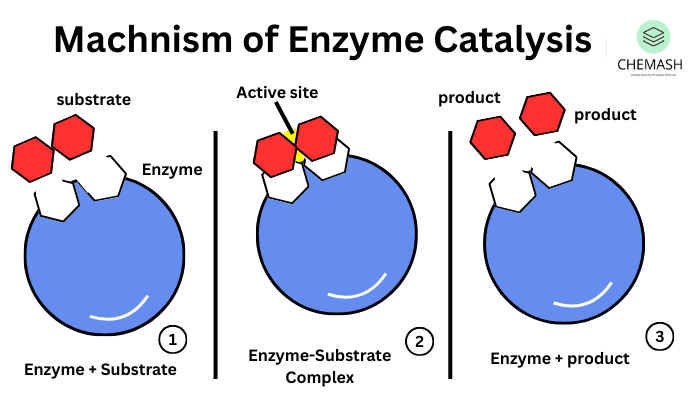
- 1️⃣ Substrate binds to the active site
- 2️⃣ Temporary enzyme-substrate complex is formed
- 3️⃣ Reaction occurs and product is released
- 4️⃣ Enzyme is ready for reuse
Factors Affecting Enzyme Activity
- Temperature – Optimum range (too high denatures enzyme)
- pH – Each enzyme has an optimal pH (e.g., pepsin = acidic)
- Substrate concentration – Higher conc. increases rate until saturation
- Enzyme concentration – More enzymes = faster rate (if substrate is available)
- Presence of inhibitors – Can block or alter the active site
Types of Enzymes (Based on Function)
- Oxidoreductases – Involved in redox reactions (e.g., dehydrogenase)
- Transferases – Transfer functional groups
- Hydrolases – Break bonds using water (e.g., protease)
- Lyases – Add/remove groups without hydrolysis
- Isomerases – Rearrange atoms within molecules
- Ligases – Join two molecules using ATP
Applications of Enzymes
- In diagnostics (e.g., blood glucose tests use glucose oxidase)
- In baking (amylase breaks starch to sugar)
- In dairy (rennet enzymes help in cheese formation)
- In detergents (proteases break stains)
- In pharmaceuticals (enzyme replacement therapies)
- In molecular biology (DNA polymerase in PCR)
Frequently Asked Questions
Q1: What are enzymes?
Enzymes are biological catalysts that accelerate chemical reactions in living organisms.
Q2: How do enzymes work?
They lower activation energy, allowing reactions to occur faster via enzyme-substrate complexes.
Q3: What factors affect enzyme activity?
Temperature, pH, substrate concentration, enzyme concentration, and inhibitors.
Q4: Where are enzymes used in industry?
Enzymes are used in baking, brewing, detergents, dairy, pharmaceuticals, and biotechnology.
Enzymes are essential for life — from digesting your food to copying your DNA. They make biology work at the speed of life!

Pingback: proteins-building-blocks-of-life