
Factors Affecting Chemical Equilibrium
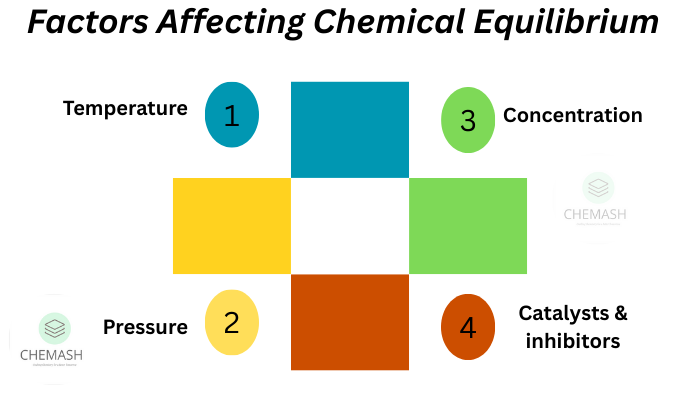
Factors Affecting Chemical Equilibrium determine how a dynamic chemical equilibrium responds to changes. Chemical equilibrium is a state where forward and backward reactions proceed at equal rates and concentrations of reactants and products remain constant; altering concentration, temperature, pressure, catalysts, or the nature of the species can shift that balance. Understanding these factors is essential for controlling reactions in labs and industry.
Contents
3. Pressure (Gaseous Reactions)
5. Nature of Reactants & ProductsSummary TableQuizFAQsReferences
1. Concentration
According to Le Chatelier’s Principle, changing the concentration of reactants or products causes the equilibrium to shift so as to reduce that change.
- Increase in reactant concentration: shifts equilibrium to the right (toward products) to consume added reactants.
- Increase in product concentration: shifts equilibrium to the left (toward reactants) to consume excess products.
- Decrease in concentration: the equilibrium shifts to replace the lost species.
Example: For N2 + 3H2 ⇌ 2NH3, adding more H2 shifts equilibrium toward ammonia formation.
2. Temperature
Temperature changes affect equilibrium based on whether the reaction is exothermic (releases heat) or endothermic (absorbs heat).
- Increase in temperature: favors the endothermic direction; decreases
Kfor exothermic reactions and increasesKfor endothermic reactions. - Decrease in temperature: favors the exothermic direction.
Example: Ammonia synthesis (exothermic) yields less ammonia at higher temperatures.
3. Pressure (For Gaseous Reactions)
Pressure mainly affects gaseous equilibria. Per Le Chatelier, changing pressure shifts equilibrium toward the side with fewer or more moles of gas to counter the change.
- Increase in pressure: shifts toward fewer moles of gas.
- Decrease in pressure: shifts toward more moles of gas.
Example: For N2(g) + 3H2(g) ⇌ 2NH3(g), increasing pressure favors ammonia formation (4 → 2 moles).
4. Catalyst
A catalyst increases reaction rates by lowering activation energy for both forward and reverse reactions but does not change the equilibrium position or the value of K.
- Speeds up attainment of equilibrium (faster approach to equilibrium).
- Does not alter equilibrium concentrations at steady state.
Example: Iron catalyst in the Haber process speeds up ammonia formation but doesn’t change final yield.
5. Nature of Reactants and Products
The chemical nature and physical state of substances influence how equilibrium responds to changes.
- Gaseous reactions are sensitive to pressure changes; reactions involving solids/liquids are not.
- Highly reactive species or those with different molecular structures can shift or reach equilibrium at different rates.
Summary Table
| Factor | Effect on Equilibrium |
|---|---|
| Concentration | Shifts equilibrium to oppose the change in concentration. |
| Temperature | Shifts toward endothermic or exothermic side depending on change; affects K. |
| Pressure | Affects gaseous equilibria; shifts toward side with fewer or more moles of gas. |
| Catalyst | Speeds up rate of approach to equilibrium, does not change equilibrium position. |
| Nature of Species | Determines sensitivity and rate at which equilibrium is established. |
MCQs
- According to Le Chatelier’s principle, adding a reactant shifts equilibrium:
- a) left
- b) right ✅
- Increasing temperature for an exothermic reaction:
- a) increases product yield
- b) decreases product yield ✅
- Which factor does NOT change the equilibrium constant
K?- a) Temperature
- b) Catalyst ✅
Quiz: Check Your Understanding
- What happens to equilibrium when the concentration of a reactant is increased?
- How does increasing temperature affect an exothermic equilibrium?
- Why does pressure only affect gaseous reactions?
- Does a catalyst change the equilibrium constant? Explain.
- Give an example where the nature of reactants influences equilibrium.
Answers:
- The equilibrium shifts toward products to consume the added reactant.
- Increasing temperature shifts equilibrium toward the reactants (endothermic direction), reducing product yield for exothermic reactions.
- Only gases exert significant pressure; solids and liquids have negligible volume change under pressure so pressure changes don’t impact them.
- No — catalysts speed both forward and reverse rates equally and don’t change equilibrium position or K.
- Gaseous reactants respond to pressure changes while solids/liquids do not; e.g., Haber process is pressure-sensitive because it involves gases.
FAQs
Q: Can pressure affect reactions with solids?
A: Generally no — pressure changes have negligible effect on equilibria involving only solids and liquids because their volumes don’t change significantly with pressure.
Q: If I add a catalyst, will equilibrium be reached at a new position?
A: No. A catalyst only speeds up the attainment of equilibrium; it does not change the final equilibrium concentrations.
Q: How does temperature change the value of the equilibrium constant?
A: Temperature alters the equilibrium constant because it changes reaction energetics. Use the van ‘t Hoff equation to quantify how K varies with temperature.
Summary
Factors affecting chemical equilibrium — concentration, temperature, pressure, catalyst and the nature of species — decide how an equilibrium position shifts or how quickly it is achieved. Mastering these controls allows chemists and engineers to optimize yields and process conditions in laboratory and industrial settings.
