
The fertilizer industry plays a critical role in global agriculture by ensuring sufficient nutrient supply for crop production. With increasing food demand and technological innovation, fertilizer production and trade have become key pillars of the global economy. This section explores the industry’s scope, market players, trade dynamics, and sustainability challenges. For background on environmental impact of fertilizer use, check our related guide. Fertilizer Industry and Global Trade
Global Fertilizer Industry Overview
The global fertilizer industry includes the production of:
- Nitrogenous fertilizers (e.g., urea, ammonium nitrate)
- Phosphatic fertilizers (e.g., superphosphate, DAP)
- Potassic fertilizers (e.g., potassium chloride)
The industry is concentrated in countries with abundant natural resources and technological infrastructure. According to the FAO Fertilizer Database, global demand continues to rise steadily.
The industry is concentrated in countries with abundant natural resources and technological infrastructure.
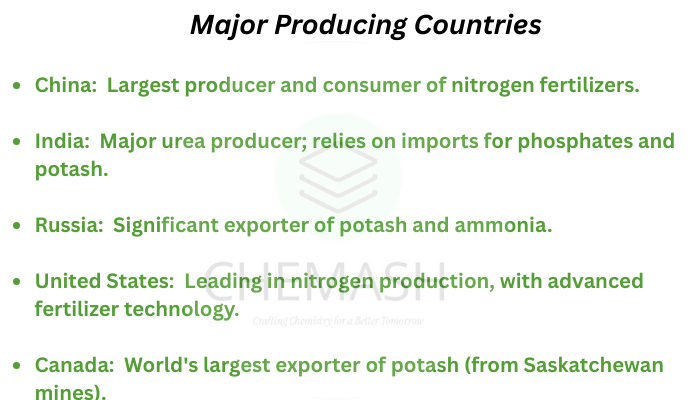
Major Producing Countries
- China: Largest producer and consumer of nitrogen fertilizers.
- India: Major urea producer; relies on imports for phosphates and potash.
- Russia: Significant exporter of potash and ammonia.
- United States: Leading in nitrogen production, with advanced fertilizer technology.
- Canada: World’s largest exporter of potash (from Saskatchewan mines).
Global Trade & Market Dynamics
Fertilizer trade is influenced by:
- Natural resource distribution: Availability of natural gas, phosphate rock, and potash deposits.
- Geopolitical factors: Sanctions, tariffs, and export restrictions can affect prices and supply chains.
- Transportation: Bulk shipping routes and port facilities determine export efficiency.
- Demand cycles: Planting seasons and crop cycles influence global prices and demand.
Sustainability and Challenges
- Carbon Footprint: Nitrogen fertilizer production emits greenhouse gases like N₂O and CO₂.
- Over-reliance on imports: Developing countries often depend on global suppliers for fertilizer security.
- Price Volatility: Global conflicts and energy crises can lead to fertilizer price shocks.
- Innovation Needs: There’s a push toward bio-based and nano-fertilizers to reduce environmental impact.
Quiz: Fertilizer Trade & Industry
1. Which country is the largest exporter of potash fertilizers?
A) India
B) Canada
C) Russia
D) Brazil
Answer: B
Explanation: Canada is the largest potash exporter globally, primarily from its reserves in Saskatchewan.
2. Why is natural gas important for nitrogen fertilizer production?
A) Acts as a pesticide
B) Fuel for irrigation
C) Raw material for ammonia synthesis
D) Catalyst for photosynthesis
Answer: C
Explanation: Natural gas provides hydrogen for the Haber-Bosch process, which synthesizes ammonia for nitrogen fertilizers.
3. What causes fertilizer price volatility globally?
A) Global fashion trends
B) Crop diversity
C) Geopolitical tensions and energy prices
D) Seasonal winds
Answer: C
Explanation: Wars, sanctions, and energy market fluctuations can disrupt supply and drive up fertilizer costs.
4. Which is a major sustainability concern in fertilizer trade?
A) Overproduction
B) Biofertilizer promotion
C) High carbon emissions
D) Use of hybrid seeds
Answer: C
Explanation: The industrial production of nitrogen fertilizers emits large volumes of greenhouse gases, contributing to global warming.
CHEMASH
