
Group 17: Halogens
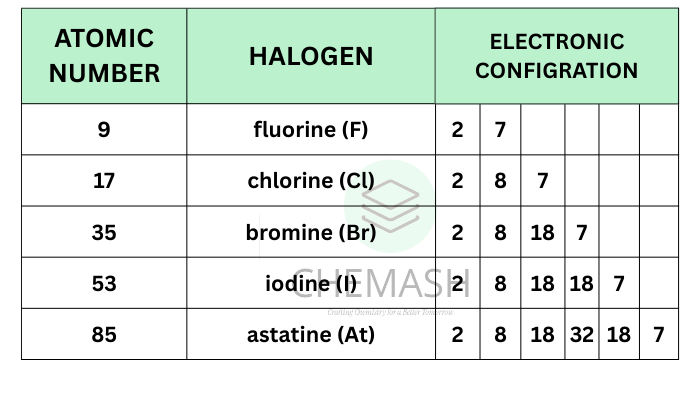
The halogens belong to Group 17 of the periodic table. They include fluorine (F), chlorine (Cl), bromine (Br), iodine (I), and astatine (At). Each halogen has seven valence electrons, making them one electron short of the stable noble gas configuration. This explains their strong reactivity and tendency to form –1 oxidation state.
Physical Properties
- States at Room Temperature: F & Cl are gases, Br is a liquid, I is a solid.
- Color: Distinctive: F (pale yellow), Cl (greenish-yellow), Br (red-brown), I (violet-black).
- Density & Melting Points: Increase down the group due to stronger Van der Waals forces.
Chemical Properties
- Reactivity: Fluorine is most reactive, astatine least. Reactivity decreases down the group.
- Oxidizing Ability: Strong oxidizers; gain electrons to form halide ions (X⁻).
- Halides Formation: React with metals (ionic halides) & non-metals (covalent halides).
- Displacement Reactions: More reactive halogen displaces less reactive one (e.g., Cl₂ displaces Br₂).
Applications of Halogens
- Disinfectants: Chlorine (water treatment), iodine (antiseptic).
- Organic Chemistry: Used in pharmaceuticals, agrochemicals, PVC.
- Lighting: Iodine in halogen lamps.
- Fluorine Compounds: Refrigerants & Teflon coatings.
Trends in Group 17
- Atomic Radius: Increases down the group.
- Electronegativity: Decreases down the group; fluorine highest.
- Electron Affinity: Decreases down the group; fluorine highest.
- Acid Strength (HX): Increases down the group (HF < HCl < HBr < HI).
MCQs: Practice Questions
- Which halogen is the most reactive?
a) Cl
b) F ✅
c) Br
d) I - Down Group 17, electronegativity:
a) Increases
b) Decreases ✅
c) Constant
d) Irregular - Which halogen is liquid at room temperature?
a) F
b) Cl
c) Br ✅
d) I
True/False Quiz
- Fluorine is the least electronegative halogen. ❌
- Boiling points of halogens increase down the group. ✅
- Chlorine can displace iodine from potassium iodide. ✅
FAQs
Q1: Why are halogens highly reactive?
Ans: They need one electron to complete their octet, making them strong oxidizers.
Q2: Which halogen is used in water purification?
Ans: Chlorine is used worldwide for disinfecting drinking water.
Q3: Why does reactivity decrease down the group?
Ans: Larger atomic size reduces effective nuclear attraction for electrons.
Related Resources

Pingback: Group 18: Noble Gases - CHEMASH