
Table of Contents
- Introduction
- Why Haloarenes Resist Nucleophilic Substitution
- Typical Reactivity Patterns
- Comparison: Haloarenes vs Haloalkanes
- Practice Sets: MCQ, Quiz, Matching, True/False, Fill-ups
- FAQ
- हिंदी संस्करण (Hindi Section)
Introduction
Haloarenes are aryl halides in which a halogen (F, Cl, Br, I) replaces a hydrogen on an aromatic ring (commonly benzene). Because of the ring’s π system, their reactivity differs markedly from haloalkanes. Key factors include resonance, hybridization, bond strength, and electronic effects. See also: Haloarenes (overview), Electrophilic Substitution. For background on aromaticity: Britannica, and terminology: IUPAC Gold Book.
Why Haloarenes Are Less Reactive Towards Nucleophilic Substitution
- 1) Resonance effect: The halogen lone pair overlaps with the ring π-system, imparting partial double-bond character to the C–X bond → stronger and harder to break.
- 2) sp² ipso carbon: The aryl carbon bearing X is sp² (more electronegative/compact) than sp³ in haloalkanes → reduced susceptibility to nucleophilic attack.
- 3) Electron distribution: The aromatic π cloud stabilizes the ipso carbon and lowers its electrophilic character.
- 4) Steric/planarity: Planar ring and delocalization restrict the approach of nucleophiles.
Typical Reactivity Patterns
1) Nucleophilic Substitution (difficult)
Usually requires harsh conditions (e.g., molten/aq. NaOH at ~300 °C, ~200 atm) or strong −M groups (e.g., NO₂ at o/p) that stabilize a Meisenheimer σ-complex (SNAr).
Example: C₆H₅Cl + NaOH (300 °C, 200 atm) → C₆H₅OH (phenol)
2) Electrophilic Substitution (favoured at o/p)
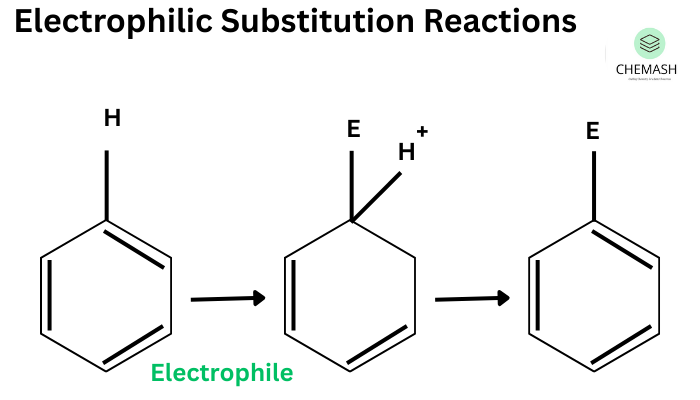
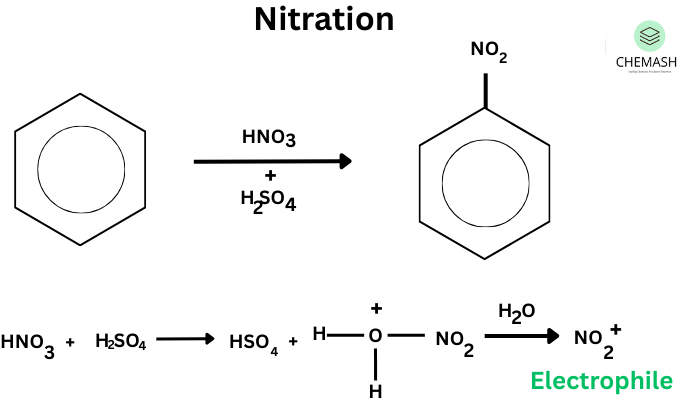
Halogen shows −I (deactivating) but also +M (o,p-directing). Therefore, nitration, sulfonation, halogenation, and Friedel–Crafts occur, albeit slower than benzene.
- Nitration: C₆H₅Cl + HNO₃ → o-/p-chloronitrobenzene
- Sulfonation / Halogenation / Friedel–Crafts: proceed at o/p positions (slower than benzene)
Comparison: Haloarenes vs Haloalkanes
| Feature | Haloalkanes | Haloarenes |
|---|---|---|
| Carbon hybridization | sp³ | sp² (ipso) |
| C–X bond reactivity | Relatively easy to break | Hard to break (partial double-bond) |
| Nucleophilic substitution | Common (SN1/SN2) | Difficult (needs harsh conditions/SNAr) |
| Electrophilic substitution | Not typical | Very common (o/p-directed) |
Practice Sets
A) (MCQ)
- Which factor most strongly reduces nucleophilic substitution in haloarenes?
- High polarity of the solvent
- Resonance giving C–X partial double-bond character
- Presence of alkyl substituents
- Low temperature
- Haloarenes usually undergo electrophilic substitution at:
- meta only
- ortho and para
- para only
- ortho only
- SNAr in aryl halides is facilitated by:
- –OH at meta
- –NO₂ at ortho/para
- –CH₃ at para
- –NH₂ at ortho
B) Quick Quiz (1-mark each)
- State one reason haloarenes resist SN1/SN2. AnswerResonance imparts partial double-bond character to C–X.
- Give the positions favored in EAS of chlorobenzene. AnswerOrtho and para.
- Name the intermediate in SNAr. AnswerMeisenheimer σ-complex.
C) Matching
- Resonance
- sp² ipso carbon
- +M effect
- −I effect
- SNAr
- o,p-directing
- Deactivating the ring
- Partial double bond in C–X
- Favoured by o/p–NO₂
- Lower susceptibility to backside attack
Answer Key
1→C, 2→E, 3→A, 4→B, 5→D.
D) True / False
- Haloarenes readily undergo SN2 with strong nucleophiles at room temperature. AnswerFalse — C–X has partial double-bond character; ipso carbon is sp².
- Halogens are overall deactivating but o,p-directing in EAS. AnswerTrue — −I deactivates; +M directs to o/p.
- SNAr is promoted by −M substituents like NO₂ at o/p. AnswerTrue.
E) Fill in the Blanks
- In haloarenes, the C–X bond exhibits __________ character. Answerpartial double-bond
- Halogens are __________-directing in electrophilic substitution. Answerortho/para
- The σ-complex formed during SNAr is called the __________ intermediate. AnswerMeisenheimer
Frequently Asked Questions
Why are haloarenes less reactive toward nucleophilic substitution?
Resonance strengthens the C–X bond (partial double-bond) and the ipso carbon is sp², reducing nucleophilic attack. Do haloarenes undergo electrophilic substitution easily?
Yes, at ortho/para positions. Halogens are o,p-directing via +M effect but overall deactivating via −I effect. When does SNAr occur?
Under harsh/basic conditions and especially when strong −M groups (e.g., NO₂) at o/p stabilize the Meisenheimer intermediate. Any good references?
See Britannica: Aromatic compounds and the IUPAC Gold Book: Substitution.
“Haloarenes resist nucleophiles but welcome electrophiles—thanks to resonance and directing effects.”
Internal reads: • Environmental impact of haloarenes
रिएक्टिविटी ऑफ़ हैलोएरीन्स (संक्षेप)
परिचय: हैलोएरीन्स (aryl halides) में बेंज़ीन जैसे एरोमैटिक रिंग पर हाइड्रोजन की जगह हैलोजन (F, Cl, Br, I) होता है। इनकी रिएक्टिविटी, हैलोएल्केन्स से अलग होती है क्योंकि रिंग का π-प्रणाली रेज़ोनांस, sp² हाइब्रिडाइज़ेशन और मज़बूत C–X बंध देती है।
हैलोएरीन्स न्यूक्लियोफिलिक सब्स्टीट्यूशन के प्रति कम सक्रिय क्यों?
- रेज़ोनांस प्रभाव: हैलोजन के lone pair का π-डीलोकलाइज़ेशन → C–X में आंशिक द्वि-बंध (partial double-bond) चरित्र।
- sp² ipso कार्बन: sp² कार्बन पर न्यूक्लियोफाइल का आक्रमण कठिन।
- इलेक्ट्रॉन वितरण व प्लैनैरिटी: रिंग इलेक्ट्रॉन घनत्व व समतलता आक्रमण को बाधित करती है।
सामान्य रिएक्टिविटी पैटर्न
- SNAr (कठोर परिस्थितियाँ): तीव्र क्षारीय/उच्च ताप व दाब, तथा o/p पर –NO₂ जैसे −M समूह होने पर मेज़ेनहाइमर इंटरमीडिएट से प्रतिक्रिया।
- इलेक्ट्रोफिलिक सब्स्टीट्यूशन: हैलोजन −I (deactivating) परंतु +M (o,p-directing) → नाइट्रेशन, सल्फोनेशन, हैलोजनेशन, फ्राइडेल–क्राफ्ट्स (धीमी पर होता है)।
तुलना: हैलोएल्केन्स बनाम हैलोएरीन्स
- हैलोएल्केन्स: sp³ कार्बन, SN1/SN2 आसान।
- हैलोएरीन्स: sp² ipso कार्बन, C–X आंशिक द्वि-बंध, SNAr/कठोर दशाएँ।
अभ्यास (Practice)
MCQ: हैलोएरीन्स में न्यूक्लियोफिलिक सब्स्टीट्यूशन कम होने का मुख्य कारण? (a) विलायक की उच्च ध्रुवीयता (b) रेज़ोनांस से C–X में आंशिक द्वि-बंध (c) अल्किल समूह (d) निम्न ताप
उत्तर: (b)
True/False: हैलोएरीन्स सामान्यतः SN2 आसानी से करते हैं — False
