
NMR Spectroscopy Basics (Nuclear Magnetic Resonance Technique)
NMR Spectroscopy Nuclear Magnetic Resonance, commonly known as NMR analysis, plays a central role in modern chemical structure determination. Chemists actively use this technique to understand molecular frameworks, hydrogen environments, and carbon skeletons with high precision.
Moreover, within the CHEMASH spectroscopy silo, this topic connects directly with Infrared Spectroscopy, UV–Visible Spectroscopy. As a result, learners gain a complete analytical perspective instead of studying isolated methods.
Table of Contents
- Introduction to Nuclear Magnetic Resonance
- Principle of NMR Technique
- Nuclear Spin and Magnetic Moment
- Resonance Condition in NMR
- Chemical Shift Concept
- Shielding and Deshielding Effects
- Reference Standard in NMR (TMS)
- Spin–Spin Coupling Interaction
- n + 1 Rule Explained
- NMR Instrumentation
- Applications of NMR Analysis
- Limitations of NMR Method
- FAQs
Introduction to Nuclear Magnetic Resonance Spectroscopy
Nuclear Magnetic Resonance spectroscopy operates on the interaction between atomic nuclei and an external magnetic field. Certain nuclei behave like microscopic magnets because they possess intrinsic angular momentum. Therefore, these nuclei respond predictably when exposed to radiofrequency radiation.
Unlike optical spectroscopy techniques, NMR provides direct information about the local chemical environment of atoms. Consequently, organic chemists rely heavily on proton and carbon NMR data for structure confirmation.
Principle of NMR Spectroscopy
The NMR principle depends on energy absorption by nuclei that have non-zero nuclear spin. When a strong magnetic field is applied, nuclear spin states split into distinct energy levels. Subsequently, radiofrequency radiation induces transitions between these levels.
Importantly, resonance occurs only when the applied frequency exactly matches the energy gap between spin states.
ΔE = hν = γhB₀ / 2π
Here, γ represents the gyromagnetic ratio, while B₀ denotes the external magnetic field strength.
Nuclear Spin and Magnetic Moment
Nuclear spin originates from the angular momentum of protons and neutrons. As a result, nuclei with odd mass numbers or odd atomic numbers show magnetic behavior. In contrast, nuclei such as 12C remain NMR inactive.
| Nucleus | Spin Value | Activity |
|---|---|---|
| ¹H | 1/2 | Active |
| ¹³C | 1/2 | Active |
| ¹²C | 0 | Inactive |
Therefore, proton NMR and carbon-13 NMR dominate structural chemistry studies.
Resonance Condition in NMR Technique
When nuclei align with or against the magnetic field, they form two energy states. The lower-energy alignment occurs parallel to the field. Once radiofrequency energy matches the energy difference, resonance takes place.
As a consequence, the spectrometer detects absorption signals corresponding to specific nuclei.
Chemical Shift in NMR Analysis
Chemical shift indicates the relative position of an NMR signal compared to a reference compound. Chemists express this value in parts per million to ensure field-independent comparison.
δ = (νsample − νreference) / νreference × 10⁶
Thus, chemical shift directly reflects the electronic environment surrounding the nucleus.
Shielding and Deshielding Effects
Electrons circulating around a nucleus generate an induced magnetic field. This field opposes the external field and shields the nucleus. Consequently, shielded protons resonate at lower δ values.
On the other hand, electron-withdrawing groups reduce shielding. As a result, deshielded nuclei resonate downfield.
Reference Standard: Tetramethylsilane (TMS)
Tetramethylsilane serves as the universal reference standard in NMR measurements. Chemists select TMS because it remains chemically inert and produces a single sharp signal.
For this reason, its chemical shift is assigned a value of exactly 0 ppm.
Spin–Spin Coupling in NMR Spectra
Spin–spin coupling arises from magnetic interactions between neighboring nonequivalent nuclei. Instead of appearing as single peaks, signals split into multiplets.
Additionally, the coupling constant (J) quantifies the spacing between split peaks and remains independent of magnetic field strength.
n + 1 Rule for Signal Splitting
According to the n + 1 rule, a proton with n equivalent neighboring protons splits into n + 1 peaks. Therefore, signal patterns reveal valuable connectivity information.
- 0 neighbors → singlet
- 1 neighbor → doublet
- 2 neighbors → triplet
- 3 neighbors → quartet
Instrumentation of NMR Spectrometer
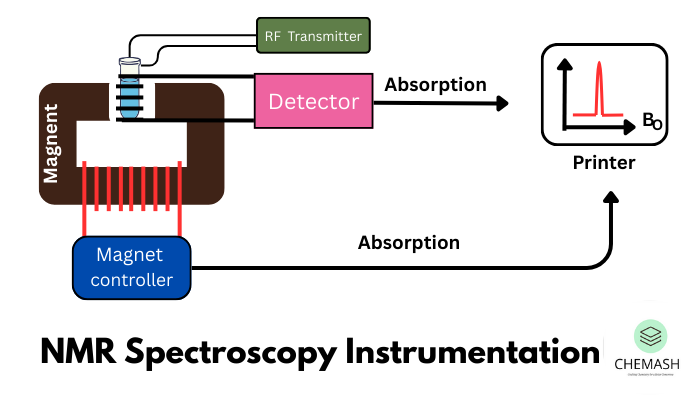
Modern NMR instruments rely on superconducting magnets and Fourier transform technology. As a result, they deliver high sensitivity and excellent resolution.
- Superconducting magnet
- Radiofrequency transmitter and receiver
- Sample probe
- Computer with FT processor
Applications of NMR Spectroscopy
Scientists actively apply NMR techniques across chemistry and life sciences. Moreover, industries use it for quality control and research.
- Organic structure elucidation
- Pharmaceutical research
- Biomolecular studies
- Polymer characterization
Limitations of NMR Method
Despite its power, NMR analysis has certain limitations. High instrument cost and relatively low sensitivity restrict its universal use. Nevertheless, its structural accuracy outweighs these drawbacks.
Frequently Asked Questions
What does NMR spectroscopy explain?
It explains molecular structure by analyzing magnetic behavior of atomic nuclei.
Why is TMS preferred as reference?
Because it produces a single sharp signal and does not interfere with sample peaks.
What information does chemical shift provide?
It reveals the electronic environment surrounding a nucleus.

Pingback: Mass Spectrometry – Principle, Mass Analyzer & Applications |
Pingback: Chromatography Techniques – Principle, Types, Applications .